 By admin
 Baking soda is being marketed everywhere as an instant eraser for wrinkles, sagging skin, and dark spots, but the truth is far more damaging: it’s essentially a chemical strip-down. While that white, chalky powder looks harmless tucked away in your pantry, using it on your face is like taking a coarse scouring pad to a delicate, fragile surface.
Apply it to skin that is already showing signs of thinning or fatigue, and you’ll instantly feel that squeaky, tight, and raw sensation that often makes smiling feel like a sting. You might notice a temporary brightness, but don’t be fooled—that shine isn’t the glow of youth; it’s the result of severe abrasion. More importantly, we need to talk about the long-term damage baking soda leaves in its wake.
The promise of vanishing lines, lifted skin, and faded spots is incredibly tempting because these are the exact insecurities we notice in the mirror every morning. The softening jawline. The crepe-like texture on the cheeks. The stubborn brown patches that seem to have taken up permanent residence.
However, your skin is not a kitchen countertop, and that is precisely where this popular skincare myth falls apart.
What baking soda is really doing under the surface
Think of your skin’s outermost layer like the fresh coat of paint on a vintage home. Baking soda doesn’t restore the wood, reinforce the structure, or fix those creaky hinges; instead, it aggressively scrapes away the top finish to create a short-lived illusion of improvement.
This is what we call a “Cellular Sandblast”: a harsh, high-alkaline reaction that strips away your natural oils, surface debris, and the vital protective moisture barrier. While your reflection might look “clean” for a few minutes, the underlying support network that keeps your skin firm and smooth is actually being depleted.
Wrinkles are not dirt. Sagging is not a stain. Dark spots are not crumbs that can be simply wiped away.
These issues stem from deep-seated changes—loss of collagen, the breakdown of elastin, shifting pigment, and years of sun exposure and stress stacking up like heavy boxes on a shelf that is already beginning to buckle. Most people focus entirely on the surface shine, but that is rarely where the real solution lies.
When you use harsh agents, your body sends a clear warning signal: first comes the tightness, then the inflammation, followed by that dry, papery texture that becomes visible every time you speak or laugh. The aftermath of these “quick fixes” is exactly why they often end up backfiring in such a visible way.
Why wrinkles and sagging don’t respond like surface grime
Wrinkles are essentially the physical collapse of your skin’s internal scaffolding. Imagine a mattress with broken springs—the fabric cover might look neat for a moment if you pull it tight, but the support system underneath remains completely compromised.
Baking soda does absolutely nothing to rebuild that internal framework. It only affects the surface, which is why you might walk away from the mirror feeling satisfied, only to find those same fine lines etched back into your skin the moment your face relaxes.
This creates a frustrating contradiction: your face might look polished, but it is actually more stressed than before.
The beauty industry knows exactly how to capitalize on this insecurity, selling the fantasy of dramatic transformations while conveniently ignoring the scientific reality that no pantry ingredient can restore a worn-out collagen scaffold. There is a reason the world’s most successful skincare empires aren’t built on cheap baking soda—and that should be your first clue.
What people truly crave isn’t the “squeaky clean” feeling; it’s skin that reflects light rather than absorbing it. However, dark spots follow entirely different rules, and that is where this skincare trap becomes even more dangerous.
Why dark spots get angrier, not lighter
Dark spots are often a lingering memory of sun damage, chronic inflammation, or repetitive irritation. They are deeper than dust; they are more like ink that has permanently stained the surface of your skin.
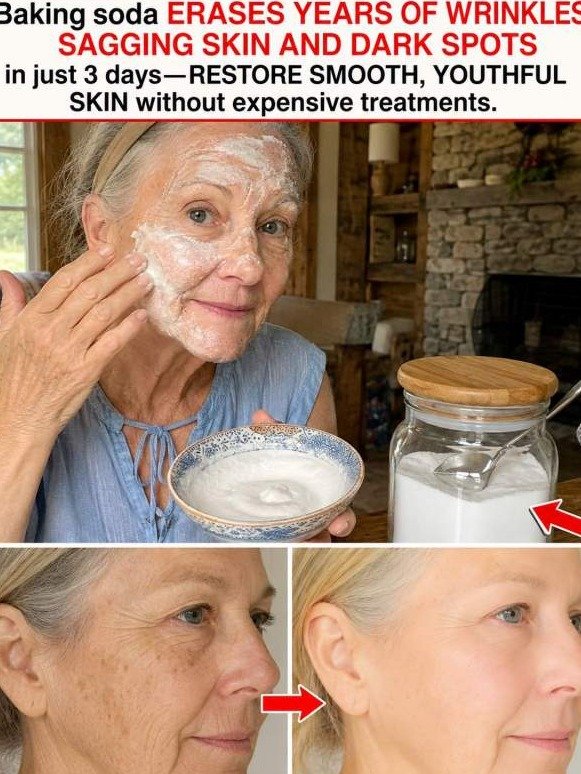
When you scrub baking soda over an uneven complexion, you might temporarily polish the top layer, but the underlying pigment remains. Worse yet, the irritation caused by the abrasive powder can trigger further inflammation, making the discoloration appear even more prominent. This is the dark side of “brightening” routines: they often aggravate the very blotchiness they claim to remove.
If you run your fingers over skin that has been over-exfoliated, you’ll feel it: a dry, brittle, and rough texture. That isn’t renewal—that is a broken barrier.
The skin remembers every insult. Once your protective barrier is compromised, moisture evaporates rapidly, redness occurs more frequently, and fine lines become deeper, catching the light in a way that emphasizes every crack.
This is why mature skin suffers the most. Thinner, drier skin is like parchment left in the sun; one harsh scrub is enough to show significant damage. Yet, many people keep chasing this shortcut, driven by the reflection they see in the mirror.
Why women notice it first in the mirror light
For many women, the realization hits around the mouth, the cheeks, and the jawline. You notice makeup settling into fine lines, and your skin—which used to glow—now looks dull and depleted.
That is when the bathroom mirror begins to feel like an enemy. One day your skin looks refreshed, and the next, it feels dry, tired, and aged.
Baking soda might provide a momentary change in texture, but it does nothing to restore the moisture barrier required for plump, resilient skin. Without that barrier, your face behaves like a parched landscape—brittle, patchy, and visibly under stress.
The relief you are looking for is actually quite simple: skin that looks vibrant, healthy, and hydrated. The good news is that your skin *will* respond—but only when you stop attacking it and start protecting it.
The surprising truth is that the solution isn’t more scrubbing. It’s less damage, more barrier-repairing support, and the kind of gentle care that allows your skin to heal. But there is one common habit that can derail your progress before you even begin.
The one step that ruins the whole effect
Many people pair an abrasive scrub with hot water or an additional harsh cleanser immediately afterward. This leaves the face red, shiny, and inflamed—much like dragging a delicate silk fabric over rough concrete.
Combining these factors turns a simple cleansing routine into a full-scale assault on your skin. The gritty residue, the heat, the manual friction, and the repetitive wiping all accumulate until your moisture barrier finally collapses.
That is the bottom line: baking soda is not a secret to youthful renewal. It is a harsh stripping agent, and when applied to already fragile skin, it accelerates the very signs of aging you are desperately trying to avoid.
There is a specific approach to skincare that completely changes the conversation regarding comfort and aging—and it doesn’t involve another abrasive scrub.
Most people keep reaching for harsher fixes, but the upcoming discussion will explain exactly why that instinct is working against your skin.
This article is for informational purposes only and does not replace professional medical advice. Please consult your healthcare provider for personalized guidance.