 By admin
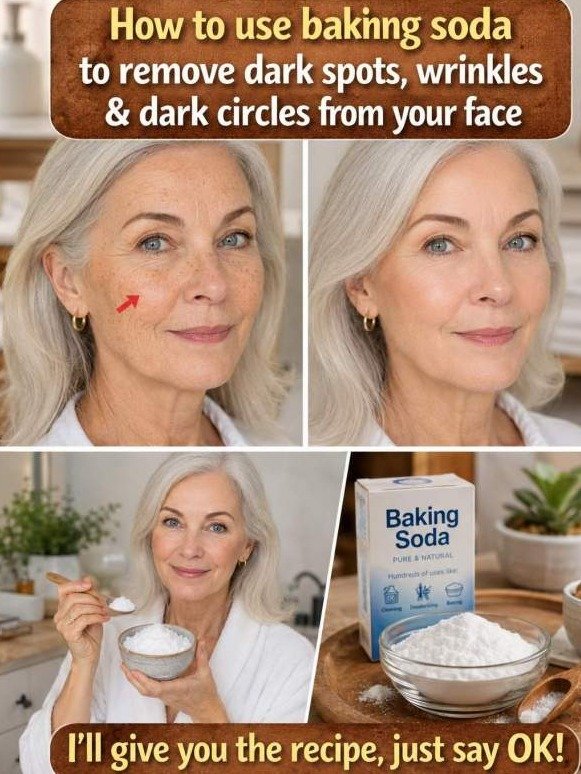
 Despite what viral trends might suggest, baking soda isn’t designed to be a gentle “beauty powder” for your complexion. This everyday kitchen staple is, in fact, a coarse, highly alkaline abrasive that begins to aggressively exfoliate the moment it makes contact with damp skin. It harshly strips away the dull, lifeless surface layer that often leaves your face looking tired and lackluster. While that fine white powder might feel innocuous when you rub it between your fingers, its effect on delicate facial skin is more akin to a miniature sandblaster targeting your skin’s outermost surface.
This aggressive scrubbing action is precisely why so many individuals, desperate to diminish dark spots, smooth out fine lines, and lighten shadowy under-eye circles, consistently turn to baking soda. They yearn for a complexion that appears less uneven, more refined, and visibly refreshed each morning. And the internet, with its endless stream of DIY hacks, continues to promote this alluring promise, often accompanied by a simple bowl, a spoon, and a reassuring smile. However, the true narrative here isn’t one of genuine “brightening” or rejuvenation. The critical story lies in the profound impact baking soda has on your skin’s vital protective barrier when it’s used too forcefully.
And this is precisely where the real problems begin to emerge. While this powerful powder effectively removes accumulated dullness from the skin’s surface, it simultaneously strips away the delicate, essential protective film that your face relies on for health and resilience. Once this crucial epidermal shield is compromised, a cascade of negative reactions intensifies: you might experience increased redness, an unpleasant rough texture, a sensation of uncomfortable tightness, and ironically, a darkening of existing pigment that makes those areas appear even more pronounced, rather than improved.
The Deceptive Surface Brightness That Transforms Your Skin’s Appearance
Imagine your complexion as a windowpane obscured by a persistent film of greasy dust and grime. When applied, baking soda behaves much like a harsh, dry cloth vigorously dragged across that glass — it temporarily clears away the haze, making the surface appear instantly cleaner, smoother, and undeniably brighter. This immediate, gratifying visual improvement is precisely why so many individuals become staunch advocates for its use.
However, this initial improvement represents only the most superficial layer of the entire story. Beneath that superficial “dusty topcoat” lies your skin’s crucial acid mantle – its natural, delicate protective shield. Baking soda, with its abrasive nature, doesn’t just clean; it aggressively bulldozes straight through this vital barrier. As soon as this delicate shield is disrupted and thrown out of balance, your face can develop an uncomfortable squeaky-clean sensation, accompanied by tightness and a peculiar rawness, much like the feeling of a painted surface that has been scrubbed so hard its protective finish begins to flake away.
Crucially, the majority of users are captivated by this fleeting glow and, in doing so, completely overlook the underlying damage that is silently accumulating. This kitchen powder lacks the ability to penetrate deep-seated pigment, it cannot miraculously erase deeply etched lines, nor does it genuinely “fix” dark circles that are often rooted in the thinness of the under-eye skin itself. Its sole action is to superficially alter what you perceive on the very top layer — and understanding this distinction makes the subsequent information exceptionally important.
The Illusion: Why Dark Spots *Appear* Lighter After Use
Often, dark spots become more pronounced and noticeable when layers of dead skin cells accumulate on the surface, much like soot blackening a pan. Baking soda’s abrasive properties effectively dislodge some of this superficial buildup, leading to the immediate perception that the pigmented area appears less prominent right after application. This, however, is merely an illusion: it’s a reduction in surface clutter, not a fundamental alteration or true “reset” of the underlying pigment within your skin.
The distinctively sharp, chalky texture of the baking soda paste contributes significantly to its perceived effectiveness. It delivers an immediate, tangible sensation of “doing something,” much like how a stiff-bristled brush can instantly make a grimy countertop appear cleaner. Yet, if you continue to scrub vigorously, that countertop will inevitably begin to show scratches — and your delicate facial skin is considerably less resilient and forgiving than a hard tile surface.
This explains why excessive use can so rapidly produce counterproductive results. A complexion intended to look clearer and more vibrant can quickly become flushed with pinkness, feel uncomfortably thirsty, and manifest irritation. Once inflammation is triggered, those persistent dark marks can actually appear even more entrenched and stubborn than they were initially. So, what exactly transpires when this same aggressive approach is directed towards delicate wrinkles and the sensitive under-eye area?
The Delicate Truth: How Fine Lines and Dark Circles Uniquely Respond
It’s crucial to understand that wrinkles are fundamentally different from mere surface dirt. They are structural changes – folds, creases, and lines formed by repeated facial expressions and the natural compression of skin over time, much like the persistent wrinkles embedded in a shirt that has been repeatedly crumpled. While baking soda might impart a fleeting sensation of smoother skin by removing superficial loose flakes, it possesses absolutely no ability to actually “fill” or diminish the depth of these intrinsic folds.
Dark circles present an even more complex challenge. The skin beneath your eyes is remarkably delicate and thin, making it transparent enough to reveal the underlying network of blue-gray blood vessels, much like a sheer curtain stretched taut over a window frame. Should baking soda be applied too closely or aggressively to this sensitive region, it can cause stinging, severe dryness, and paradoxically, make the area appear even more harshly shadowed. This occurs because the skin loses essential moisture, becoming even more translucent and emphasizing the underlying vascularity.
Here lies the cruel irony: the very delicate areas people are most eager to brighten and improve are frequently the ones that end up looking significantly worse after excessive or improper scrubbing. Furthermore, while social media platforms enthusiastically promote “natural” ingredients as a universal green light for skincare, your skin itself is indifferent to the label on a product. Its response is dictated by chemistry and biology, not by marketing buzzwords.
The Critical Detail The Beauty Industry Often Overlooks
Think of your skin’s protective barrier as a meticulously constructed brick wall, where the mortar is essential for its integrity. Baking soda doesn’t merely “knock” on this wall’s door; it aggressively begins to dissolve and loosen the crucial mortar holding it together. Once this structural integrity is compromised, vital moisture rapidly escapes, while external irritants easily penetrate. This is precisely when your face can begin to feel unpleasantly hot, uncomfortably tight, and surprisingly sensitive even to skincare products you used without issue just the day before.
This fundamental truth explains why a seemingly inexpensive ingredient from the grocery store’s cheapest aisle can inadvertently lead to the most challenging and costly skin issues. The vast skincare industry thrives on promoting intricate formulations, luxurious packaging, and extensive ingredient lists. A simple, unassuming box of baking soda, however, doesn’t generate revenue for advertisements, influencer campaigns, or glossy marketing promises. Consequently, the crucial warning signs regarding its misuse are often obscured and buried beneath the alluring fantasy of “easy” and affordable beauty solutions.
And understandably, this realization often sparks genuine frustration and anger. Consumers are continually encouraged to pursue brightening, smoothing, and de-puffing effects, yet they are rarely informed that the very paste they’re using can transform a calm, healthy complexion into a stressed, reactive one, particularly if their skin barrier is already compromised. The positive aspect, however, is that these outcomes aren’t arbitrary or random; the precise method and frequency of application profoundly alter the results.
Understanding What a *Truly* Safer Application Entails
Should someone still feel compelled to experiment with baking soda on their skin, the only sensible approach is one that is exceptionally brief, incredibly gentle, and used very infrequently. A minuscule quantity, thoroughly blended with water or honey, should be applied in a manner that functions more as a swift, superficial sweep rather than an aggressive, deep scrub. Furthermore, the application motion must be so feather-light that it barely causes any discernible movement of the skin itself.
Envision this: standing before your bathroom mirror, a lightly dampened face, and a meticulously prepared paste with a faint, clean mineral aroma. Perform one single, exceedingly careful pass over the desired area, then immediately rinse it away. Absolutely avoid aggressive circular motions, steer clear of the delicate eye area and lip line, and resist the temptation to think, “What if I leave it on longer?” Your objective here is solely a cleaner surface, not a harshly stripped, compromised one.
Following this minimal application, your face will desperately require moisture, much like a parched sponge thirsts for water. Neglecting this crucial hydration step will likely leave your skin feeling uncomfortably papery and tight by the afternoon, particularly noticeable around the delicate cheekbones and under-eye regions. This specific post-treatment sensation serves as a vital clue that most individuals unfortunately disregard, yet it unmistakably signals the subsequent adverse reactions that are likely to occur.
The Desired “After” Picture (And How to Actually Achieve It Safely)
When the accumulation of surface dead skin cells is minimal, and crucially, your skin’s protective barrier remains fully intact and healthy, your complexion can indeed appear less dull and noticeably more vibrant. Makeup glides on more smoothly and adheres better. Your skin reflects light with greater uniformity, banishing that tired, washed-out appearance in the mirror that often makes one look exhausted even before the day has truly begun.
This is the genuine allure of such a superficial treatment: it’s not a magical transformation, but rather a temporary removal of the outermost skin layer. However, if your skin begins to sting, shows visible flushing, or feels uncomfortably tight after rinsing, it’s a clear indication that the process has veered from mildly helpful to actively hostile. Continuing with subsequent applications will only further exacerbate the damage to that already compromised protective barrier.
Beyond the application method, there’s a common kitchen habit that subtly, yet profoundly, undermines the entire process, and its tell-tale sign is often evident in the very consistency of the paste you create…
The critical mistake many individuals make is preparing the paste either too concentrated, excessively gritty, or, even worse, combining it with highly acidic ingredients like lemon juice or vinegar. This transforms a potentially mild paste into a burning, fizzing concoction that can leave your face intensely red, irritated, and unpleasantly shiny for many hours. Furthermore, another crucial factor that dramatically impacts the outcome is the precise order in which ingredients are combined – a nuanced detail that nearly everyone overlooks or misunderstands.
Please note: This article is intended solely for informational purposes and should not be considered a substitute for professional medical or dermatological advice. Always consult with your qualified healthcare provider for personalized guidance and recommendations regarding your specific skin concerns and health needs.