 By admin
 You’ve likely seen the viral tips touting baking soda as a miraculous solution for everything from dark spots to wrinkles and under-eye circles, promising an instant, radiant glow. However, what many don’t realize is that this seemingly harmless white powder acts more like a harsh chemical sandblaster on your delicate complexion. While it can rapidly scour away dead surface cells, creating a momentary illusion of brightness, beneath that fleeting shine, it violently disrupts your skin’s natural pH balance, leaving its protective barrier feeling raw, painfully tight, and deeply irritated.
This crucial, damaging effect is often invisible in the immediate aftermath when you glance in the bathroom mirror. You might notice a seemingly smoother cheek and mistakenly believe the underlying skin issue is being resolved, but in reality, your skin’s vital surface has merely been aggressively stripped, much like a delicate countertop scoured with an abrasive, inappropriate cleaner.
Furthermore, apply this same abrasive paste to the incredibly thin and sensitive skin around your eyes, and that supposed “DIY glow trick” rapidly transforms into a painful, stinging, and burning ordeal. The true concern isn’t whether baking soda alters your complexion; it’s the severe and damaging cascade of reactions it compels your skin to undertake in response.
Why the quick brightening fools so many people
Persistent dark spots typically reside much deeper within your skin’s intricate layers, akin to deep-seated stains woven into the fabric itself, rather than simply resting on the surface. While baking soda might aggressively abrade the outermost layer, it only creates a superficial illusion of cleanliness or brightness for a brief period, much like quickly fluffing a well-worn rug just before company arrives.
This is precisely why the immediate outcome can feel so convincing. Your complexion might appear momentarily less dull, your fingertips might detect a surprisingly smoother texture, and the mirror offers a fleeting sense of accomplishment. Yet, the fundamental causes of these discolorations – whether they stem from sun damage, chronic inflammation, hormonal fluctuations, or lingering acne marks – remain entirely unaddressed and undisturbed deep within your skin.
The truly detrimental consequence is that this repetitive, harsh scrubbing actually conditions your skin to react with increasing intensity, rather than fostering a sense of calm. Instead of fading, redness intensifies, an uncomfortable dryness takes hold, and your entire face begins to behave as if it’s been aggressively scoured with harsh dish powder, completely disregarding its nature as delicate, living tissue.
This compromised state directly exacerbates the issue of wrinkles, as a stressed and damaged skin barrier inevitably causes your face to reveal signs of aging in a far more pronounced and accelerated manner.
Why wrinkles look worse after the wrong kind of exfoliation
It’s crucial to understand that wrinkles are not merely surface impurities; they are the undeniable visual testament to underlying collagen degradation, cumulative sun damage, and the relentless pressure of time, etching themselves onto the skin much like permanent creases on an old, frequently folded map.
Baking soda, unfortunately, offers no solution for restoring this damaged “map.” Its action is limited to superficially stripping away a thin layer of the epidermis, which might impart a transient sensation of softness. However, this fleeting smoothness bears no resemblance to genuine structural support. It’s akin to merely polishing a cracked and decaying wooden table, rather than undertaking the essential work of rebuilding the compromised wood beneath its surface.
The majority of individuals halt their assessment at the initial, smooth-to-the-touch sensation, completely overlooking the profound and detrimental tradeoff occurring beneath the surface. While your skin might indeed appear polished for a fleeting hour, it will soon begin to feel uncomfortably tight, fragile and papery, or exhibit an unsettling sensitivity, especially when exposed to light once more.
There’s a clear and immediate reason why this “solution” so often backfires: with a compromised and stripped skin barrier, vital moisture rapidly evaporates, leading to increased dehydration. Consequently, every fine line and subtle wrinkle becomes more pronounced and begins to cast a noticeably harsher shadow than it did previously.
The actual process at play here is far from a beneficial “beauty hack”; it’s more accurately described as a severe Barrier Shock Reset. This rapid, superficial alteration of the skin’s surface invariably initiates a much slower, more insidious, and ultimately uglier cascade of reactions beneath. However, it’s around the delicate eye area where this particular gamble becomes exceptionally perilous.
Why dark circles under the eyes are the worst place to gamble
The skin beneath your eyes is remarkably delicate, so translucent that it readily reveals every late night, every allergic reaction, and even the slightest fluid retention. It’s comparable to a fragile piece of tissue paper meticulously stretched over a frame; just one application of a harsh, unsuitable product can cause the entire area to wrinkle prematurely, sting painfully, or even begin to peel.
Applying baking soda to this vulnerable region typically results in a gritty, uncomfortably hot, and utterly unforgiving sensation. This isn’t a sign that the product is “working” or being effective; instead, it’s a clear and immediate signal of profound irritation manifesting itself on the most sensitive patch of your entire face.
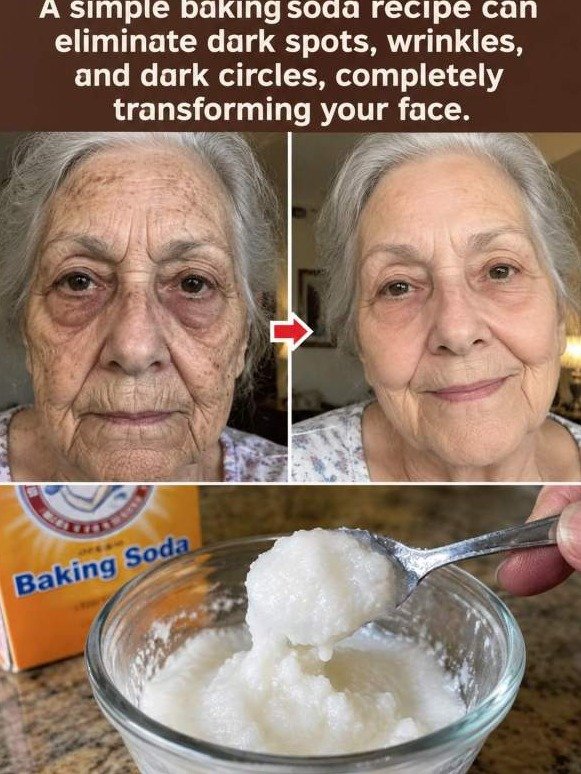
Dark circles are frequently linked to a complex interplay of genetic predispositions, persistent puffiness, underlying pigmentation issues, or chronic fatigue. A harsh, abrasive paste offers no genuine solution for any of these root causes. Instead, it merely compounds the problem by introducing yet another issue: a visibly red, inflamed, and irritated ring that ironically makes the under-eye area appear even more fatigued and worn out.
This is precisely why individuals who desperately seek a rapid brightening effect often find themselves with a complexion that appears significantly more inflamed and irritated rather than genuinely refreshed. The paradox here is truly brutal: the very substance they applied hoping to appear more awake and vibrant can tragically leave their skin looking even more exhausted and compromised.
Despite these severe drawbacks, the reason this problematic “beauty recipe” continues to circulate widely online is straightforward: it delivers an immediate, albeit fleeting, visual gratification. However, the subsequent section will unveil the truly safer and more effective approaches that genuinely make a difference for your skin.
What actually helps the face look calmer, clearer, and less worn down
If we consider dark spots as persistent stains, then the genuine solution is emphatically not through more aggressive scrubbing. Instead, the real fix lies in actively preventing the recurrence and deepening of these discolorations, while simultaneously providing your skin with the essential biological nourishment it requires to effectively rebuild a more resilient and even surface.
This holistic approach mandates daily, consistent sunscreen application, as relentless sun exposure continuously fuels pigment production, much like oxygen intensifies a flame. It necessitates thorough hydration, given that dehydrated skin invariably accentuates the depth and roughness of fine lines. Crucially, it involves incorporating scientifically proven ingredients such as vitamin C, niacinamide, hyaluronic acid, and retinol – these are the sophisticated tools designed to collaborate harmoniously with your skin’s natural processes, rather than harshly abrading it like an old cooking pan.
Envision a morning where your face retains its comfort and suppleness well past noon, where your makeup applies flawlessly and adheres more smoothly, and where your under-eye area appears rested and serene, rather than looking as though it endured a strenuous battle before breakfast. This idyllic scenario vividly illustrates the profound distinction between a superficial, temporary peel and the transformative benefits of a meticulously crafted, consistent skincare routine.
This positive transformation first manifests in the tangible sensation of your skin, followed by a noticeable improvement in how it beautifully reflects light. You’ll experience significantly less stinging, a reduction in undesirable roughness, and the complete absence of that tell-tale chalky, over-stripped appearance that unmistakably broadcasts, “I subjected my skin to something far too harsh last night.”
Once this remarkable difference becomes unmistakably clear and undeniable, your perspective will fundamentally shift. The question will no longer be, “What quick fix can I smear on my face for instant results?” but rather, “What hidden factors are silently undermining and sabotaging my skin’s health and appearance before I even begin?”
The one kitchen habit that ruins the whole experiment
The most insidious pitfall in this entire “experiment” is the tendency to apply the paste with increased vigor and pressure. The granular particles of baking soda scrape across your skin’s delicate surface like microscopic shards of chalk being dragged over glass. The more force individuals exert, the more aggressively they compromise and strip away the very protective barrier they were misguidedly attempting to enhance.
This explains why a complexion can rapidly transition from appearing momentarily brighter to becoming overtly irritated and inflamed within mere hours. While the baking soda paste might seem innocuous enough when resting in a bowl, the moment it’s aggressively applied across sensitive skin – particularly around the vulnerable eye area – it ceases to be a superficial beauty trick and instead begins to inflict damage akin to a slow-motion chemical surface burn.
Furthermore, there’s an additional critical detail that fundamentally alters the entire outcome, and surprisingly, it bears no relation to the duration for which you leave the paste on your skin.
Ultimately, it is the combination of ingredients and application technique that definitively determines whether this practice remains a fleeting, short-lived cosmetic illusion or tragically devolves into a painfully red, inflamed, and flaky dermatological disaster.
This article is for informational purposes only and does not replace professional medical advice. Please consult your healthcare provider for personalized guidance.