 By admin
 Why Bruises Change Colors: Understanding the Science and What Easy Bruising Implies
From an unexpected bump on the furniture to a minor knock, most of us are familiar with the appearance of a bruise. These colorful marks, which evolve through shades of red, purple, green, yellow, and brown, can often seem perplexing, even a little concerning. If you’ve ever pondered why your bruises exhibit different hues than others or why certain individuals seem to develop them with minimal impact, rest assured, you’re not alone. Delving into the fascinating science behind bruise coloration and the phenomenon of easy bruising can offer clarity, alleviate worries, and equip you with effective strategies for managing them. Furthermore, beyond simply waiting for them to disappear, there’s a straightforward practice many tend to overlook that could significantly accelerate their healing process. Continue reading to uncover the complete explanation.
The Dynamic Science Behind Bruise Color Transformations
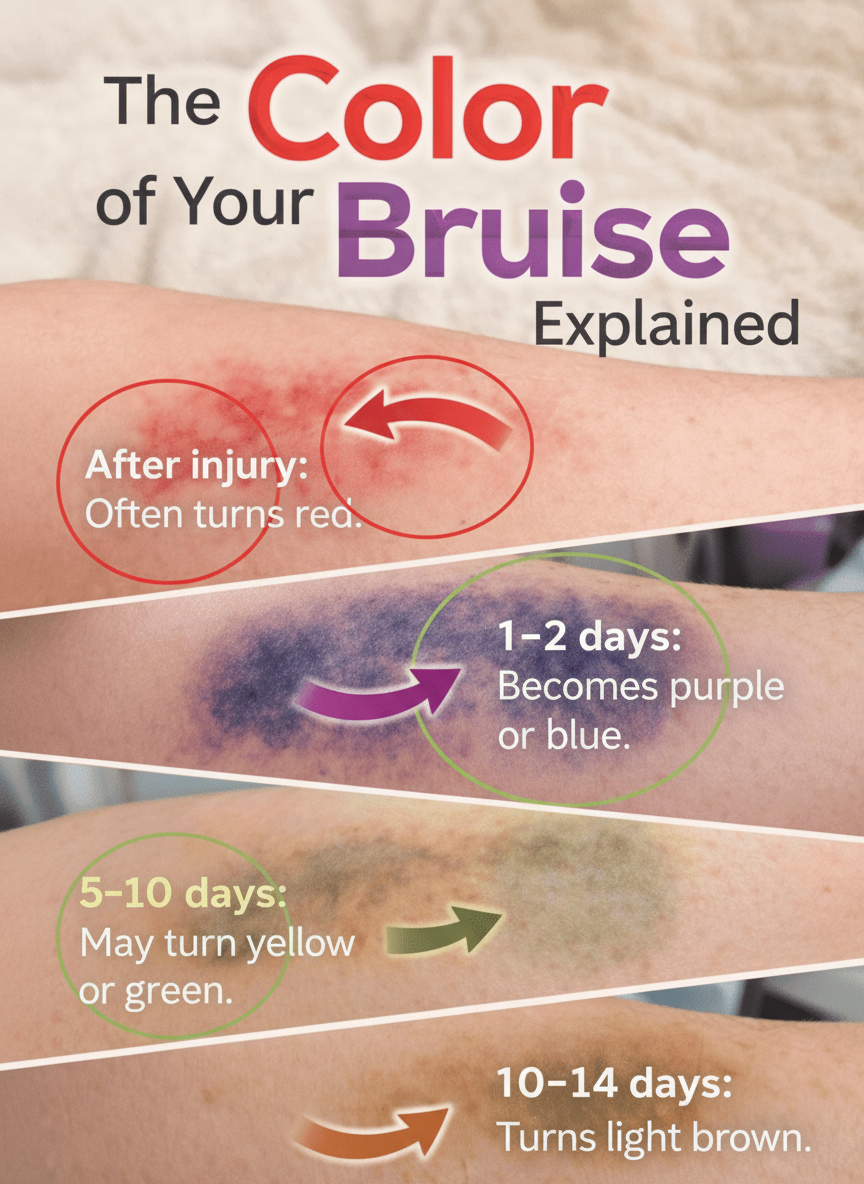
A bruise, medically known as a contusion, is essentially your body’s visible reaction to localized trauma beneath the skin’s surface. Tiny blood vessels, known as capillaries, rupture, causing blood to seep into the adjacent soft tissues. This collection of trapped blood is precisely what forms the distinctive mark we see. Initially, immediately following an injury, a bruise frequently presents as red, indicative of fresh, oxygenated blood. However, this is merely the commencement of a remarkable physiological process driven by your body’s inherent healing and waste removal mechanisms.
Over the subsequent 24 to 48 hours, as the leaked blood begins to deoxygenate, the bruise typically transitions to shades of purplish-blue or even black. This chromatic shift occurs because hemoglobin, the iron-containing protein within red blood cells responsible for oxygen transport, alters its structure in the absence of oxygen. Following this, the body initiates a crucial breakdown phase. Specialized cells from your immune system are dispatched to metabolize the hemoglobin into various other compounds, leading to further color changes:
- Approximately 5 to 10 days post-injury, the bruise may take on a green hue, a result of the pigment biliverdin.
- Subsequently, it often turns yellow as biliverdin is further broken down into bilirubin.
- Within 10 to 14 days, the bruise commonly lightens to a yellow-brown or pale brown shade before ultimately vanishing.
This systematic evolution of colors is a testament to your body efficiently reabsorbing and processing the extravasated blood components. Medical authorities, including WebMD and the Mayo Clinic, confirm that while this timeline can exhibit minor variations influenced by factors such as age, individual skin complexion, and the extent of the bruise, the fundamental sequence of color changes remains strikingly consistent. Furthermore, skin pigmentation significantly influences how bruises are perceived. On individuals with lighter skin tones, the progression through red, purple, green, and yellow stages tends to be more pronounced and vivid. Conversely, on darker skin tones, bruises might appear uniformly darker or display more subtle shifts towards deep purples or various brown shades.
Understanding Why Certain Individuals Bruise More Easily
It’s a common observation: some people develop prominent, dark bruises from seemingly minor impacts, while others exhibit hardly a trace. The phenomenon of easy bruising is more widespread than many realize, and its prevalence can typically be attributed to several contributing elements.
- The Impact of Aging: With advancing age, our skin naturally undergoes thinning and a reduction in its subcutaneous fat layer, which ordinarily provides cushioning. Concurrently, blood vessels become increasingly delicate and situated closer to the skin’s surface, rendering them more susceptible to damage from everyday bumps. Research consistently identifies this as a primary reason for the heightened incidence of bruising in adults, particularly those over the age of 50.
- Medications and Dietary Supplements: A range of commonly prescribed medications and even some over-the-counter supplements can influence the body’s clotting mechanisms, thereby increasing the propensity for bruising. Notable examples include anticoagulant medications (often called blood thinners) such as aspirin and warfarin, as well as non-steroidal anti-inflammatory drugs (NSAIDs) like ibuprofen. Certain herbal remedies can also have similar effects.
- Crucial Nutritional Deficiencies: Insufficient intake or absorption of vital nutrients like Vitamin C and Vitamin K can compromise the integrity of blood vessel walls or impair the blood’s ability to clot effectively. While acute deficiencies are uncommon, even suboptimal levels can contribute to easier bruising in certain individuals. Vitamin C is essential for collagen production, which supports vessel strength, and Vitamin K is critical for synthesizing clotting proteins.
- Genetic Predisposition and Underlying Health Conditions: For some, a genetic predisposition leads to naturally more fragile capillaries, making them prone to bruising inherited through family lines. In rare circumstances, persistent or unusually severe easy bruising might signal a more serious underlying medical condition, such as a bleeding disorder or certain liver diseases. If you experience frequent, unexplained bruises, or if they are unusually large or painful, it is highly advisable to consult a healthcare professional for a thorough evaluation to exclude any potential underlying health concerns.
Effective Strategies to Accelerate Bruise Healing
Fortunately, you don’t have to passively endure the healing process. Proactive, straightforward measures can significantly aid your body’s inherent repair mechanisms, potentially diminishing swelling, alleviating discomfort, and improving the overall appearance of the bruise. Here are several evidence-backed recommendations you can implement immediately:
- Initial Cold Compression (Ice): Immediately following the injury, apply an ice pack or a cold compress, wrapped in a thin cloth, to the affected area for 15-20 minutes. Repeat this several times a day for the first 24-48 hours. The cold temperature constricts local blood vessels, thereby minimizing further blood leakage into the surrounding tissues and potentially limiting the bruise’s size and severity.
- Elevate the Injured Area: Whenever possible, particularly if the bruise is on a limb (arm or leg), elevate it above heart level while resting. This utilizes gravity to help reduce blood pooling and subsequent swelling, which can lessen both discomfort and the visual prominence of the bruise.
- Introduce Warmth After 48 Hours: Once the initial 48-hour period has passed, transition from cold to warm therapy. Applying a warm compress or a heating pad to the bruise increases localized blood flow. This enhanced circulation assists your body in more efficiently clearing away the broken-down blood components and metabolic waste products, thus speeding up the fading process.
- Adequate Rest for the Affected Site: Protect the bruised area from further trauma or strenuous activity. Excessive movement or impact can exacerbate the injury, potentially prolonging the healing time or worsening the bruise. Allowing the area to rest supports the body’s natural repair processes without interruption.
Bruises, while often a minor inconvenience, offer a fascinating glimpse into our body’s resilience and complex healing capabilities. Understanding the science behind their changing colors and the factors contributing to easy bruising can transform a moment of concern into an opportunity for proactive self-care. By adopting simple, effective strategies, you can not only help your bruises heal faster but also gain a deeper appreciation for your body’s intricate workings. Remember, if you have persistent concerns about unexplained or severe bruising, always consult with a healthcare professional for personalized advice and reassurance.