 By admin
 The Vaseline Method: A Gentle, Natural Approach to Removing Skin Tags at Home
Skin tags are those small, soft, benign growths of skin that, while harmless, can be quite bothersome. They often appear in areas prone to friction like the neck, armpits, eyelids, groin, or under the breasts. Many seek a quick, painless, and natural way to remove them at home. The Vaseline method, combined with simple household items, has emerged as a popular and surprisingly effective DIY solution for many.
Important Reality Check: Not an “Overnight” Miracle
Despite viral claims, no method—natural or medical—reliably removes a skin tag for everyone in just one night. Most home remedies, including the Vaseline-based approaches, require consistent application over 3 to 14 days for the tag to darken, dry up, and eventually fall off naturally. Claims of instant removal are often exaggerated or apply only to exceptionally small, loose tags.
However, the Vaseline method is widely recognized as one of the gentlest, safest, and most popular natural techniques that truly works for many when applied correctly.
How Vaseline & Natural Irritants Work for Skin Tags
Vaseline (petroleum jelly) itself doesn’t remove skin tags. Its role is crucial as an occlusive barrier that:
- Softens the tag: By trapping moisture, it helps prepare the tag for removal.
- Protects surrounding skin: It prevents the active irritant from affecting healthy skin.
- Keeps irritant in contact: It ensures the active ingredient stays focused on the tag, accelerating the drying and darkening process.
When paired with a mild natural irritant, this combination gradually cuts off the blood supply to the skin tag, causing it to necrose (die) and detach.
Top 3 Proven Vaseline-Based Skin Tag Removal Methods
1. Vaseline + Tea Tree Oil (Most Popular & Gentle)
Why it works: Tea tree oil is known for its strong antimicrobial properties and mild irritating effect, which induces controlled inflammation to dry out the tag. Vaseline protects the healthy skin and enhances the oil’s action.
How to do it:
- Clean and thoroughly dry the skin tag area.
- Apply a very thin layer of pure Vaseline around the base of the tag to protect normal skin.
- Dip a clean cotton swab in 100% tea tree essential oil and dab it directly onto the skin tag only.
- Cover the treated tag with a small amount of Vaseline on top to seal the tea tree oil in.
- (Optional): Cover with a small bandage.
- Leave on overnight. Repeat this process every night.
Timeline: Most users observe the tag darkening, shrinking, and falling off within 3–10 days (average 5–7 days).
2. Vaseline + Garlic (Stronger but More Irritating)
Why it works: Garlic contains allicin, a potent compound with antimicrobial and irritating properties that can accelerate the drying of the skin tag.
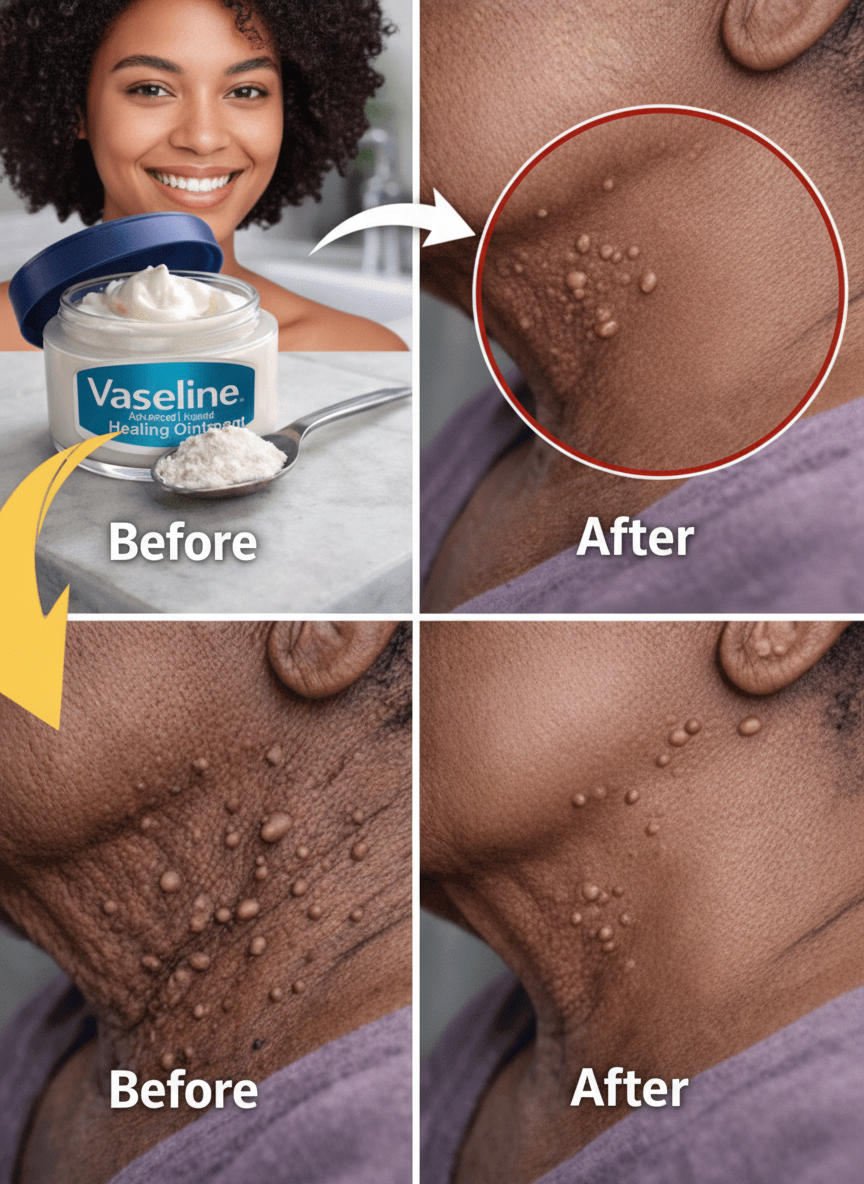
How to do it:
- Crush 1 small fresh garlic clove and let it sit for 10 minutes to activate its compounds.
- Apply Vaseline around the base of the skin tag.
- Dab a tiny amount of the crushed garlic directly onto the tag.
- Cover with another layer of Vaseline, and bandage if necessary.
- Leave on overnight and rinse the area in the morning.
Timeline: Expect darkening and fall-off within 4–10 days.
3. Vaseline + Baking Soda Paste (Gentler Abrasive Method)
Why it works: Baking soda provides a mild abrasive action that helps to dry out the tag’s surface, while Vaseline protects the surrounding skin.
How to do it:
- Mix 1 teaspoon of baking soda with just enough water to form a thick paste.
- Apply Vaseline around the base of the skin tag.
- Dab the baking soda paste directly onto the tag.
- Cover with a small amount of Vaseline on top.
- Leave on overnight and rinse in the morning.
Timeline: Gradual drying and fall-off typically occur within 7–14 days.
Realistic Expectations & Timeline for Results
- Days 1–3: The skin tag usually darkens (to brown or black) and may shrink slightly.
- Days 4–10: Most tags will dry up, scab over, and fall off naturally. This process is generally painless if done correctly.
- 2–4 Weeks: Larger tags may take longer for complete removal; the skin typically heals flat without scarring.
Success Rate: Approximately 60–85% of consistent users report full removal within 1–3 weeks. This method works best on small to medium-sized tags (pea-sized or smaller).
Crucial Safety Warnings (Do NOT Skip These!)
Your safety is paramount. Please adhere to these warnings:
- Never cut or tie off skin tags at home: This carries a high risk of infection, significant bleeding, and permanent scarring.
- Exercise extreme caution on sensitive areas: Avoid using these methods on the face, eyelids, or genital areas without consulting a dermatologist, as the skin there is much thinner and more sensitive.
- Always patch test: Before full application, apply the mixture to a small, inconspicuous area (like the inner arm) 24 hours prior to check for adverse reactions.
- Discontinue use immediately: If you experience severe redness, burning, excessive swelling, or observe pus, stop the treatment and consult a healthcare professional.
- Seek professional medical advice if: The skin tag bleeds, grows rapidly, changes color or shape, or becomes painful. These could be signs of a more serious skin condition, potentially even skin cancer.
- Not for children: Do NOT use these methods on children without explicit approval from a pediatrician.
The Bottom Line
The Vaseline method, when combined with natural irritants like tea tree oil, garlic, or baking soda, offers a gentle, cost-effective, and often effective natural way to remove small skin tags at home. While it’s not an instant solution, consistent application typically yields results within 3–14 days with minimal discomfort or scarring. Always prioritize safety and consult a professional for any concerns.