 By admin
 The Ultimate Guide to Spinal Health: How Your Sleep Posture Can Transform Your Mornings
Do you frequently greet the morning with persistent stiffness, a dull ache in your lower back, or nagging neck discomfort that shadows your entire day? You might be surprised to learn that your sleep posture – the way your body rests for those crucial 7-9 hours – profoundly impacts your spinal health and overall well-being. Suboptimal spinal alignment during sleep can place undue stress on your muscles, joints, and nerves, potentially making even simple daily movements feel challenging.
The encouraging news is that achieving better spinal alignment and alleviating morning discomfort might be simpler than you think. Even minor adjustments to your sleeping habits, such as strategic pillow placement, can yield significant improvements in how refreshed and mobile you feel. This comprehensive guide will explore expert-recommended sleep positions to embrace and common habits you should reconsider for a healthier spine.
Why Your Sleep Posture is Crucial for Spinal Health
Your spine is a marvel of engineering, featuring natural S-shaped curves designed to absorb shock, facilitate movement, and provide essential support for your entire body. When you sleep, the goal is to maintain these natural curves in a “neutral” position. This minimizes uneven pressure on your intervertebral discs, surrounding muscles, and sensitive nerves, which are vital for a pain-free existence.
Extensive research, including studies specifically investigating the link between sleep posture and spinal symptoms, consistently demonstrates that individuals who adopt positions promoting neutral spinal alignment report significantly less morning discomfort. Essentially, when your spine is properly aligned, it enters a restorative state, allowing it to recover from the stresses and strains of the day. Conversely, inadequate support permits gravity and your body weight to pull your spine out of alignment, leading to cumulative tension and potential long-term issues.
Optimal Sleep Positions for Superior Spinal Alignment
Health professionals widely endorse several sleep positions that actively contribute to maintaining a neutral spine. The key to success in these postures lies in the strategic use of pillows to support your body’s natural contours.
1. Back Sleeping with Knee Support
Often hailed as the gold standard for comprehensive spinal support, sleeping on your back promotes an even distribution of body weight. The crucial element here is placing a small pillow or a rolled towel directly under your knees. This simple addition helps preserve the natural inward curve of your lower back (lumbar spine), effectively reducing strain on the lumbar muscles and discs.
How to Implement: Begin by using a relatively thin pillow for your head to ensure your neck remains in a neutral position – avoid pillows that are too thick or too flat. Adjust the support under your knees until your lower back feels comfortably settled and supported against the mattress.
2. Side Sleeping with a Pillow Between Your Knees
Side sleeping is a widely favored position that can be highly beneficial for your spine when executed correctly. This posture inherently helps align your hips, pelvis, and spine, especially if your knees are slightly bent towards your chest.
Key Tip: To prevent your upper leg from dropping forward and twisting your lower spine, tuck a firm pillow securely between your knees. A full-body pillow can offer excellent comprehensive support. Furthermore, select a head pillow that adequately fills the gap between your shoulder and your ear, ensuring your neck remains level with your spine.
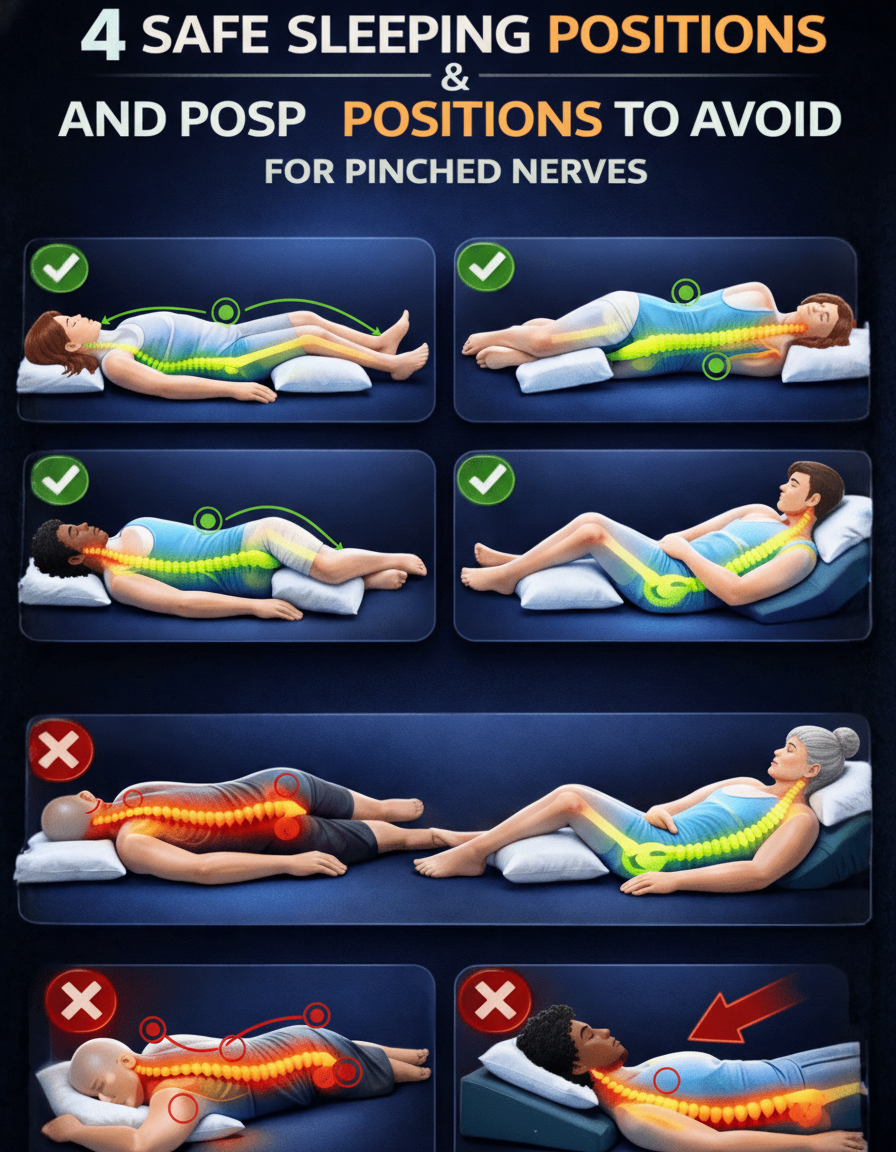
3. Slightly Reclined with Upper Body Support
For some individuals, particularly those who experience tension in flat positions, a semi-reclined posture (often achieved with an adjustable bed or recliner) can be exceptionally soothing. This position can create more space between vertebrae and significantly reduce pressure points.
Practical Setup: Use several pillows to gently elevate your upper body to an angle of approximately 30-45 degrees. Crucially, remember to add support under your knees to maintain comfort in your lower back and prevent it from arching.
4. Back Sleeping with Optimized Neck Support
This variation of back sleeping specifically zeroes in on ideal head and neck alignment. The objective is to use a pillow that perfectly cradles the natural curve of your neck without forcing your chin towards your chest or hyperextending it backward. Investing in an ergonomic neck pillow can make a significant difference here.
These recommended positions are designed to foster neutral spinal alignment, a principle that numerous health authorities link directly to a substantial reduction in overnight strain and discomfort.
Sleep Positions and Habits to Re-evaluate for Spinal Well-being
While some sleeping positions promote healing and alignment, others can actively undermine your spinal health. It’s vital to recognize and, where possible, modify habits that introduce unnecessary pressure and strain.
Positions to Limit or Avoid:
- Stomach Sleeping: This is arguably the most detrimental position for your spine. It severely flattens the natural curve of your lower back and compels your neck to twist sharply to one side for breathing, creating significant, uneven stress across your entire spine. Research consistently highlights prone (stomach) sleeping as a major contributor to increased spinal stress compared to supported back or side positions.
- Excessive Head Pillow Use: Stacking multiple pillows under your head might feel comfortable initially, but it pushes your head forward at an unnatural angle. This sustained forward flexion places immense strain on your cervical spine (neck) over several hours, leading to stiffness and pain.
- Lack of Strategic Pillow Support: Neglecting to use pillows in critical areas, such as under your neck or between your knees, can allow your hips and shoulders to fall out of alignment. This often results in awkward, twisted postures that pull on your lower back and compromise overall spinal neutrality.
- Extreme or Unsupported Twisted/Curled Positions: While a gentle fetal position can be fine with proper support, extreme curling or sleeping with legs unevenly placed (e.g., one leg straight, one bent without support) can create torque and tension in your lower back, leading to discomfort.
Quick Overview: Supportive vs. Problematic Sleep Postures
To help you quickly identify beneficial and potentially harmful sleep habits, here’s a concise comparison:
| Supportive (Embrace These) | Often Problematic (Limit or Avoid) |
|---|---|
| Back sleeping with a pillow under knees (promotes even weight distribution, lumbar support). | Stomach sleeping (flattens lumbar curve, twists neck, high spinal stress). |
| Side sleeping with a pillow between knees (maintains hip-spine alignment, prevents lower back twist). | Using too many pillows under the head (strains cervical spine). |
| Slightly reclined position with upper body and knee support (reduces pressure points, can alleviate tension). | Sleeping without adequate neck or knee support (leads to misalignment and twisted postures). |
| Back sleeping with neutral neck support (ensures proper cervical alignment). | Extreme or unsupported curled/twisted positions (puts strain on lower back). |