 By admin
 Hair thinning, breakage, and a lack of luster are common concerns that many individuals silently grapple with, often cycling through countless products without achieving desired results. This relentless pursuit can lead to frustration and even discouragement, especially when expensive treatments fail to deliver on their promises. In this landscape, humble, time-honored ingredients—such as onion—have sparked renewed interest, bolstered by emerging scientific studies and centuries of traditional application. By the conclusion of this comprehensive guide, you will not only understand the scientific perspective on utilizing onion for hair care but also uncover a surprisingly straightforward practice at the end that many tend to overlook.
The Resurgence of Onion in Hair Care Research
While onion might initially seem like an unconventional choice for hair remedies, its integration into traditional beauty practices spans generations across various cultures in Asia, the Middle East, and Africa. Modern fascination with onion juice and onion-infused oils stems from their rich nutrient composition and a growing, albeit modest, body of research. Yet, the true intrigue of onion doesn’t lie in a single ‘miracle’ component, but rather in the synergistic interplay of its diverse natural elements.
Understanding Onion’s Hair-Boosting Nutrients
Onions are packed with a blend of bioactive compounds that researchers postulate may significantly contribute to both scalp vitality and hair strength:
- Sulfur-rich compounds: Sulfur is a fundamental constituent of keratin, the primary protein responsible for the structure and resilience of hair strands.
- Flavonoids (e.g., quercetin): These potent antioxidants actively combat oxidative stress, a significant factor implicated in scalp aging and hair damage.
- Natural antimicrobial properties: Onions possess inherent qualities that can help regulate the proliferation of specific bacteria and fungi on the scalp, fostering a healthier environment.
Indeed, optimal hair health often originates beneath the surface, at the scalp. When the scalp ecosystem is well-supported and balanced, hair follicles are better positioned to encourage robust growth and maintain their inherent strength.
Scientific Insights: What Research Reveals About Onion and Hair
While the overall scientific evidence concerning onion’s direct impact on hair health remains somewhat limited, one frequently referenced study has significantly propelled public and scientific interest.
The Groundbreaking 2002 Journal of Dermatology Study
A small-scale clinical trial published in the Journal of Dermatology in 2002 involved participants experiencing alopecia areata (patchy hair loss) who applied onion juice topically to their scalps. After a period of several weeks, the group using onion juice demonstrated notably more visible hair regrowth when compared to participants who applied only plain water. However, it is crucial to consider the context of these findings:
- The study involved a small cohort of participants.
- Individual results exhibited considerable variation.
- The researchers underscored the imperative for more extensive and rigorous investigations.
Nevertheless, this initial research suggested that onion juice could potentially aid hair regrowth in specific scenarios, likely attributable to its sulfur content and antioxidant capabilities. Crucially, the study did not assert that onion “cures” hair loss. Instead, it positioned onion as a promising supportive element within a holistic hair care regimen.
Onion Juice vs. Onion Hair Oil: A Comparative Look
Many individuals are understandably hesitant to use raw onion juice due to its pungent aroma and potential for scalp irritation, particularly for sensitive skin. This is precisely where onion hair oil emerges as a more agreeable and gentle alternative.
Onion Juice
- Highly concentrated active compounds.
- Possesses a very strong, distinct odor.
- Has a relatively short shelf life.
- Carries a higher risk of scalp irritation for those with sensitive skin.
Onion Hair Oil
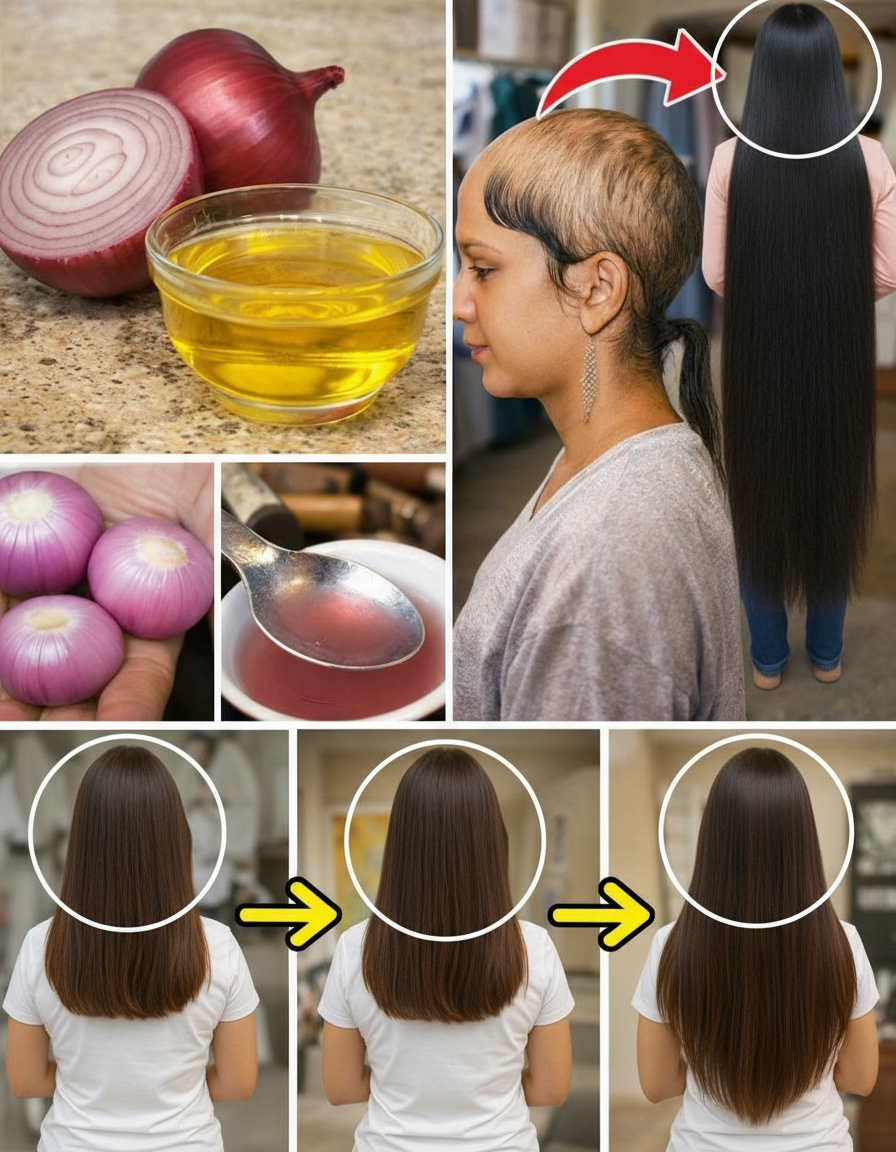
- Diluted effectively with a nourishing carrier oil.
- Exhibits a significantly milder fragrance.
- Offers a considerably longer shelf life.
- Generally much better tolerated on the scalp, even for sensitive types.
Given these distinct advantages, onion-infused oil is typically the preferred choice for consistent and regular hair care applications.
DIY Onion Hair Oil: Essential Ingredients and Tools
A key factor contributing to the widespread appeal of homemade onion hair oil is its straightforward preparation. You won’t require specialized equipment or hard-to-find components.
Ingredients
- 1 large red or yellow onion
- 1/2 cup carrier oil (coconut oil is excellent, but olive oil or castor oil are also effective alternatives)
- Optional: 5–10 drops of preferred essential oils (lavender or rosemary can enhance fragrance and offer additional benefits)
Tools
- Grater or a high-speed blender
- Cheesecloth or a fine-mesh strainer
- Small saucepan
- Clean glass jar with an airtight lid for storage
Before you begin the preparation process, it’s vital to grasp one critical detail: maintaining low heat is paramount. Excessive heat can inadvertently degrade the beneficial plant compounds present in the onion, diminishing the oil’s efficacy.
Crafting Your Own Onion Hair Oil: A Step-by-Step Guide
Step 1: Extract the Onion Juice
Begin by peeling and finely chopping the onion. Process it in a blender or grate it until you achieve a pulpy consistency. Next, use a cheesecloth or a fine sieve to thoroughly strain the pulp, collecting all the extracted juice. Be aware that the aroma will be quite strong at this stage; however, it will mellow considerably once blended with the oil.
Step 2: Prepare the Oil Infusion
Gently pour your chosen carrier oil (e.g., coconut oil) into a small saucepan. Warm it over very low heat until it has just melted, ensuring it does not boil. Carefully add the freshly extracted onion juice to the warmed oil and stir continuously and slowly. Allow this mixture to simmer gently on extremely low heat for approximately 5–10 minutes. A crucial indicator often overlooked: if the oil begins to sizzle, your heat setting is too high and needs to be reduced immediately.
Step 3: Cool and Store Your Infused Oil
Remove the saucepan from the heat source. Allow the onion-infused oil to cool completely to room temperature. Once cooled, carefully strain the oil one more time through a fine sieve or cheesecloth to remove any remaining onion particles. Transfer the clarified oil into a clean, airtight glass jar. Store it in a cool, dark place to preserve its potency and extend its shelf life.