 By admin
 Our skin is a dynamic organ, constantly changing and reacting to our environment. It’s common for new spots, bumps, or rashes to appear, often leaving us feeling uncertain or even anxious. Differentiating between various skin changes can be confusing, making it hard to know when to seek professional advice. Fortunately, dermatologists employ precise terminology to categorize these alterations based on their visual and tactile characteristics, providing a clear framework for understanding what’s happening on your skin’s surface. This guide aims to demystify the most common types of primary skin lesions, presenting them in straightforward language to help you confidently identify key distinctions. Be sure to read until the end, where we’ll share a practical self-check guide—a crucial tool often overlooked—that can significantly inform your next steps in managing your skin health.
Understanding Skin Lesions: Definition and Importance
At its core, a skin lesion refers to any unusual variation in your skin’s appearance, whether it’s a shift in color, a change in texture, or an alteration in shape. Specifically, primary lesions are those that manifest directly as a result of an underlying skin condition or process, offering immediate clues about what might be affecting your skin. The purpose of understanding these fundamental types is not to encourage self-diagnosis, but rather to empower you with knowledge. This informed perspective allows for more effective and productive discussions with your healthcare provider. Research from reputable dermatology organizations consistently highlights that a basic understanding of these categories can lead to earlier detection of concerning changes. This heightened awareness is a critical factor in facilitating timely medical consultations, which are paramount for maintaining optimal skin health. With this foundation laid, let’s explore the distinct categories of common primary skin lesions.
Exploring Common Primary Skin Lesions: A Detailed Overview
To help you better navigate the world of skin problems, here’s a straightforward breakdown of the most frequently encountered primary skin lesions, explained according to standard dermatological classifications.
Macule: The Flat Discoloration
A macule is characterized by being a flat area of altered skin color, distinctly different from the surrounding skin. Imagine common examples like freckles, sunspots (also known as age spots), or small, flat moles. Crucially, macules are non-palpable; running your finger over them reveals no change in texture or elevation. They typically measure less than 1 centimeter in diameter, roughly the size of a pencil eraser. While often benign, their appearance can be linked to factors such as sun exposure or underlying skin conditions.
Papule: The Small, Solid Bump
Transitioning from flat lesions, a papule presents as a small, solid, and palpable elevation on the skin. These raised bumps are generally less than 1 centimeter in size and possess a firm consistency when touched. Everyday instances include the individual lesions of acne, insect bites, or small warts. Papules can vary in color, appearing red, pink, flesh-toned, or even pigmented, and it’s not uncommon for them to form clusters.
Plaque: The Elevated, Flat-Topped Patch
A plaque develops when multiple papules coalesce or when a single papule expands to become a larger, raised, and distinctly flat-topped area, exceeding 1 centimeter in diameter. These lesions often feel like thickened skin and may exhibit a scaly or rough texture. Plaques are a hallmark feature of various skin conditions, most notably psoriasis, where they manifest as prominent, elevated patches across significant areas of the body.
Vesicle: The Small, Fluid-Filled Blister
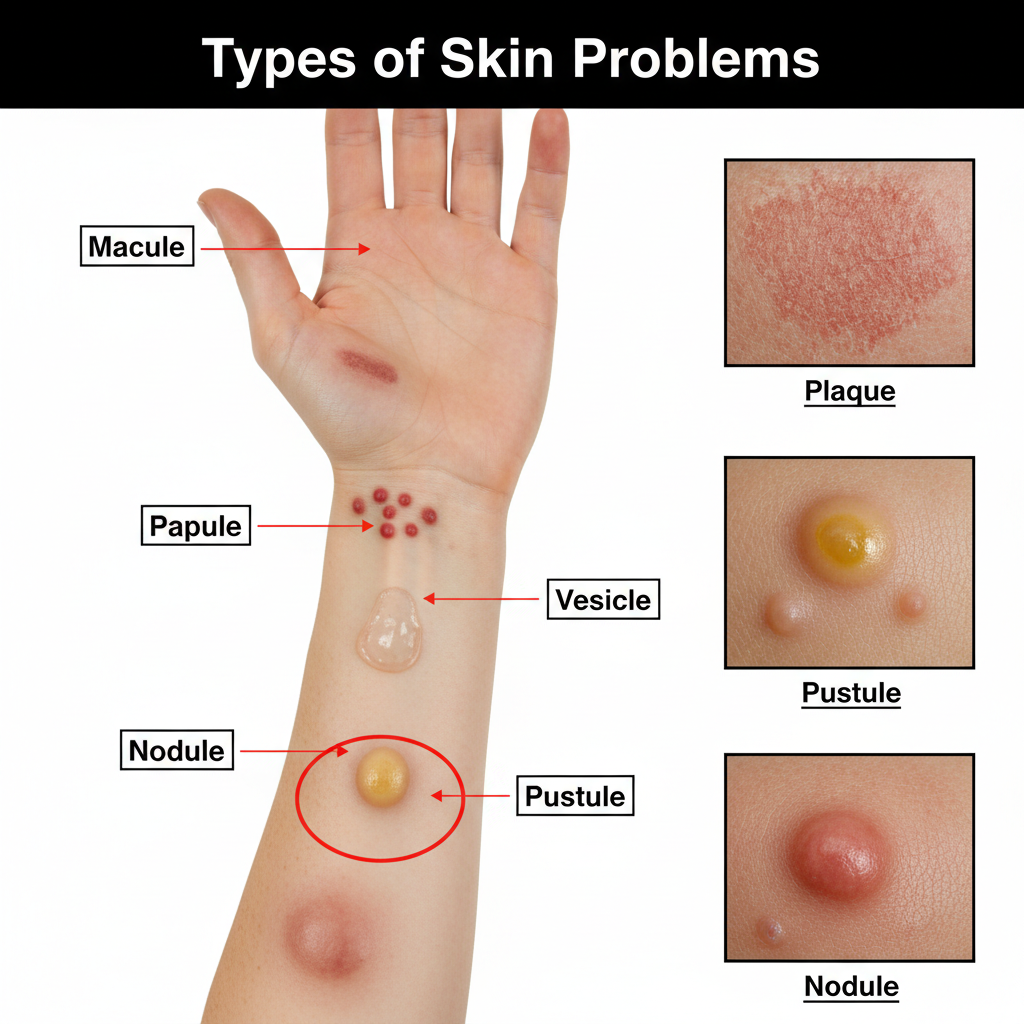
Delving into fluid-filled lesions, a vesicle is a small blister, typically less than 1 centimeter in size, containing clear fluid. These appear as delicate, transparent bubbles just beneath the skin’s surface and can feel either soft or taut. Vesicles are commonly associated with conditions such as contact dermatitis or various viral infections, and due to their fragile nature, they are prone to rupture.
Bulla: The Larger Fluid-Filled Blister
A bulla is essentially a larger counterpart to a vesicle, defined by its size exceeding 1 centimeter. These more substantial fluid-filled blisters can arise from various causes, including burns, intense friction (such as from ill-fitting footwear), or other forms of skin irritation. Bullae often have a soft, “squishy” feel and may contain fluid that is either clear or somewhat cloudy.
Pustule: The Pus-Filled Bump
Pustules are distinctive raised lesions characterized by their visible content of pus, which typically gives them a white or yellowish central appearance. These are generally small, measuring less than 1 centimeter, and can often be tender to the touch. Pustules are frequently observed in conditions like acne and folliculitis, where bacterial infection or inflammation leads to the accumulation of purulent material.
Nodule: The Deep, Solid Lump
Unlike surface-level lesions, nodules penetrate deeper into the skin, presenting as solid, firm lumps that originate beneath the skin’s outermost layer. These are typically larger than 1 centimeter and are felt as distinct, hard masses under the skin. Common examples include certain types of cysts or deeply inflamed lesions. A key characteristic is their palpability, even when the skin’s surface above them appears relatively undisturbed.
To provide a clearer visual understanding of these distinctions, here’s a concise comparison table summarizing the key features of each primary skin lesion:
- Flat & Non-Palpable: Macule (primarily a color change)
- Small, Raised, Solid (<1 cm): Papule
- Large, Raised, Solid (>1 cm): Plaque (surface elevation) or Nodule (deeper tissue involvement)
- Small, Fluid-Filled (<1 cm): Vesicle
- Large, Fluid-Filled (>1 cm): Bulla
- Pus-Filled, Raised: Pustule
Your Skin Health Self-Check Checklist: When to Seek Professional Advice
While understanding these lesion types is incredibly helpful, knowing when to seek professional medical advice is paramount. Most skin blemishes are harmless, yet certain indicators warrant immediate attention from a healthcare professional. This section serves as your essential Self-Check Checklist, inspired by guidelines from leading organizations such as the American Academy of Dermatology, to help you identify potential warning signs:
- Rapidly Spreading Rash: Any rash that expands quickly across a significant area of your body.
- Painful, Hot, or Swollen Spots: Lesions accompanied by pain, warmth, or swelling, which could indicate a possible infection.
- Persistent Blisters or Open Sores: Any blisters or open wounds that fail to heal completely within one to two weeks.
- Changing Moles or Spots: Pay close attention to any existing mole or new spot that exhibits changes in its size, shape, color, or texture, or if it starts to itch or bleed.
Remember, this checklist is a guide, not a diagnostic tool. When in doubt about any skin changes, always consult with a dermatologist or your primary care physician. Early detection and professional evaluation are crucial for effective management of any concerning skin conditions.