 By admin
 You stand up, and a familiar twinge hits your knee or shoulder. Is it just age? A bit of stiffness? Many of us dismiss these pains, living with the nagging uncertainty of whether the discomfort stems from a joint, a muscle, or a ligament. This confusion isn’t just frustrating; misunderstanding the source of your pain can lead to actions that worsen it.
The good news? Your body provides clues. Learning to recognize these subtle signals empowers you to make smarter daily choices. By the end of this article, you’ll grasp the simple distinctions that even healthcare professionals use to pinpoint the origin of your pain.
Understanding Joint Pain
Joint pain originates where two bones meet, such as your knees, shoulders, hips, or elbows. These complex areas contain cartilage, fluid, and soft tissues designed for smooth movement. When these structures are irritated, the discomfort often feels deep-seated, “inside the bone,” rather than superficial.
Key Indicators of Joint Pain:
- A deep, persistent ache, often described as being “inside the bone.”
- Stiffness, particularly noticeable upon waking in the morning.
- Pain that emerges or intensifies during movement (e.g., walking, climbing stairs).
- Mild swelling around the affected joint.
Joint pain tends to be slow and persistent, often developing gradually over months or even years. It’s frequently associated with age-related cartilage wear, internal inflammation, long-term strain from repetitive movements, or reduced mobility. However, it’s a common mistake to assume all pain around a joint is joint pain itself. This brings us to our next distinction.
Understanding Muscle Pain
Unlike joint pain, muscle pain typically arises from the muscles surrounding the joint. Think of the soreness after an intense workout or a day of heavy gardening – that’s classic muscle discomfort. Muscle pain is generally easier to pinpoint with your fingers.
Key Indicators of Muscle Pain:
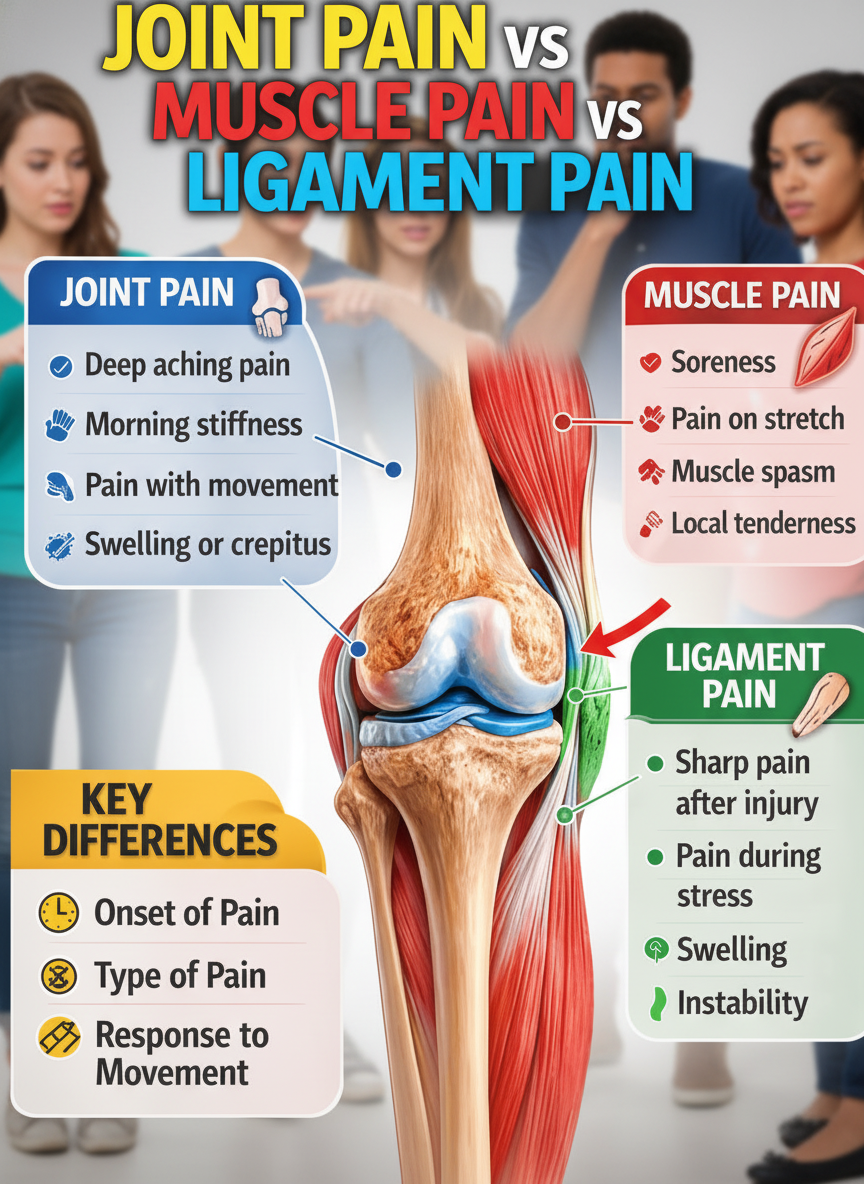
- Soreness, tightness, or a dull ache in a specific muscle area.
- Pain that occurs when stretching or contracting the affected muscle.
- Temporary muscle cramps or spasms.
- Tenderness when pressing directly on the muscle.
A crucial difference is its timing: muscle pain often appears after activity, frequently manifesting as delayed onset muscle soreness (DOMS) 12 to 48 hours post-exertion. Furthermore, muscle pain usually improves with gentle movement, stretching, and rest. In contrast, joint pain may worsen with heavy joint use, offering a clear diagnostic clue.
Understanding Ligament Pain
Ligaments are tough, fibrous bands of tissue that connect bones to other bones, providing stability to your joints and preventing excessive movement. Ligament pain typically occurs when a ligament is overstretched or subjected to sudden force, often appearing immediately after an awkward movement or minor injury.
Key Indicators of Ligament Pain:
- Sharp, acute pain felt immediately after a twist, fall, or sudden impact.
- Discomfort or pain when the joint is bearing weight or under pressure.
- Noticeable swelling around the joint area.
- A feeling of instability or weakness in the affected joint.
While common in athletes (e.g., knee or ankle sprains), everyday scenarios like slipping, stepping awkwardly, or twisting a knee can also cause ligament injuries. A surprising aspect of ligament pain is its potential to linger for weeks, even from minor strains, due to ligaments having a poorer blood supply compared to muscles. This slow healing often necessitates careful movement and patience during recovery.
The Simple Rule: Observing Key Differences
Many adults struggle to differentiate these pains because they often manifest in similar body areas. However, family doctors often rely on three simple clues to quickly identify the source: onset, sensation, and reaction to movement.
| Feature | Joint Pain | Muscle Pain | Ligament Pain |
|---|---|---|---|
| Location | Deep inside the joint | Specific muscle area (surface) | Around joint edges, specific ligament path |
| Onset | Gradual, develops over time | After activity (often delayed 12-48 hrs) | Sudden, immediately after injury/awkward movement |
| Sensation | Deep ache, stiffness, “inside bone” | Soreness, tightness, cramps, tenderness | Sharp, acute pain, instability, weakness |
| Reaction to Movement | Pain during movement, worsens with heavy use | Improves with gentle movement, stretching, rest | Pain under pressure/weight, feeling of instability |
By paying close attention to these distinctions, you can better understand what your body is trying to tell you, enabling you to make informed decisions about your daily activities and when to seek professional advice.