 By admin
 A Breakthrough in Dental Care: New Gel Promises Natural Tooth Enamel Restoration
Tooth enamel, the hardest substance in the human body, serves as our teeth’s primary defense. Yet, it faces relentless assault from daily activities like consuming acidic beverages, indulging in sugary snacks, or even vigorous brushing. Crucially, once enamel suffers wear or erosion, the body lacks any inherent mechanism to repair it, leaving teeth vulnerable to increased sensitivity, discoloration, and potential decay that can escalate into more severe oral health issues. Many individuals silently endure these problems, often resorting to invasive procedures such as fillings, crowns, or veneers, which demand ongoing maintenance and can be uncomfortable. But what if a revolutionary, gentler solution were on the horizon—one that draws inspiration from the very process of enamel formation?
Groundbreaking research emanating from the University of Nottingham has unveiled a highly promising, protein-based gel that ingeniously replicates the body’s natural enamel-building process. Continue reading to delve into how this innovative solution functions in laboratory settings and why it has the potential to fundamentally transform discussions around dental care. There’s a fascinating detail about its real-world applicability waiting to be discovered.
Understanding Tooth Enamel and Its Critical Role
Serving as a vital protective shield, tooth enamel safeguards the more delicate layers of the tooth beneath it. It is densely composed of hydroxyapatite crystals, meticulously arranged in a highly organized structure that bestows upon teeth their remarkable strength and lustrous appearance. Regrettably, unlike other tissues, enamel possesses no regenerative capacity. Various factors, including highly acidic foods, insufficient oral hygiene, teeth grinding (bruxism), or age-related attrition, can induce demineralization. This process involves the leaching of essential minerals, rendering the enamel surface rough, porous, and significantly weakened. The consequences often manifest as:
- Elevated tooth sensitivity to hot, cold, or sweet stimuli.
- A chalky or yellowish hue as the underlying dentin becomes more visible.
- A heightened susceptibility to cavities forming in compromised areas.
Conventional dental interventions primarily concentrate on preventing further damage or camouflaging existing issues. However, they fall short of truly restoring the original, intricate structure of the enamel.
The Innovation: A Bio-Inspired Gel from Nottingham Researchers
A dedicated team spearheaded by researchers at the University of Nottingham’s School of Pharmacy and Department of Chemical and Environmental Engineering has successfully engineered a unique gel. This formulation leverages synthetic proteins known as elastin-like recombinamers (ELRs). These ELRs are specifically designed to function as a temporary scaffold, mirroring the role of natural proteins (such as amelogenin) that orchestrate enamel crystal formation during a child’s developmental stages.
Here’s an insight into how this remarkable process unfolds during rigorous lab tests:
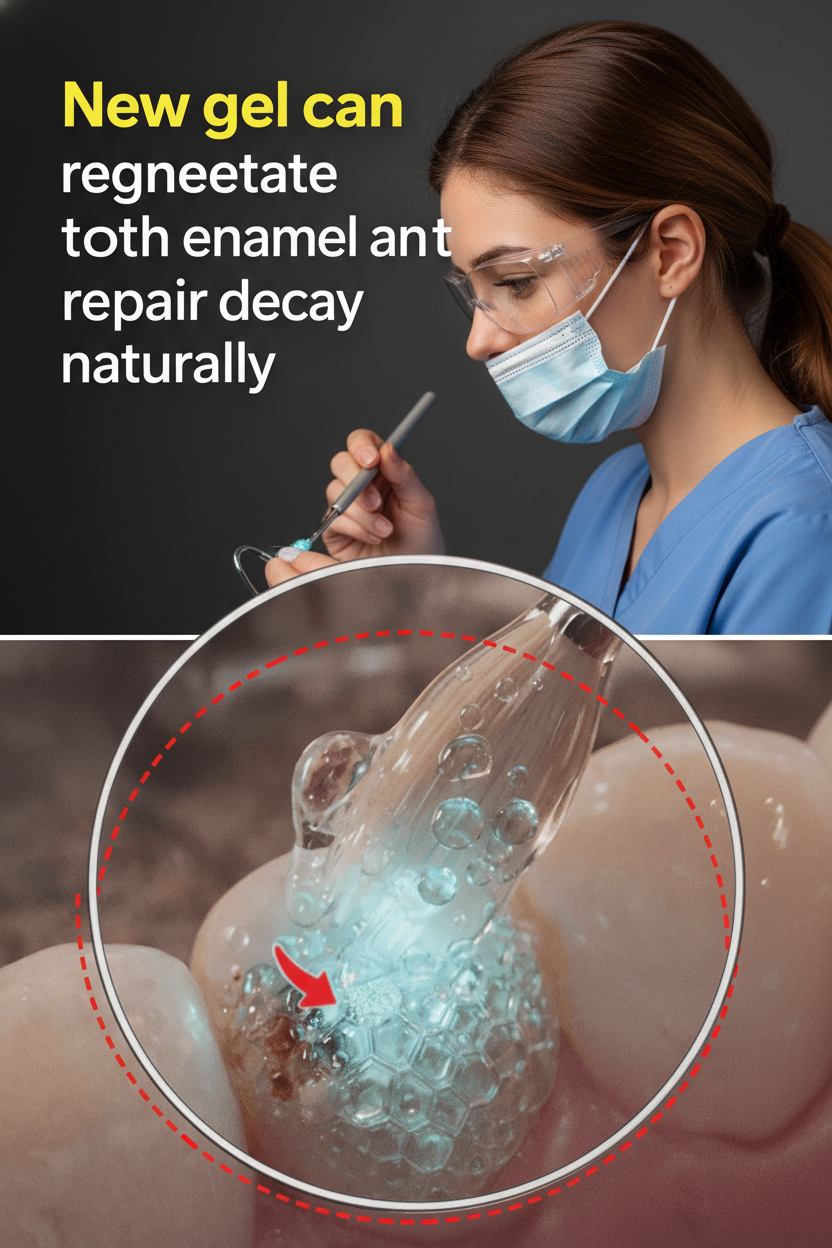
- The specialized gel is meticulously applied to areas of demineralized or eroded enamel surfaces, and even to exposed dentin.
- Upon application, it establishes a thin, intricate layer that actively attracts calcium and phosphate ions, which are naturally abundant in saliva.
- This interaction initiates the highly organized growth of new hydroxyapatite crystals, which precisely align with the tooth’s pre-existing architectural framework.
The compelling outcome is a regenerated layer that strikingly mirrors natural enamel in both its complex structure and visual aesthetics. Studies, published in Nature Communications in 2025, have demonstrated that this regeneration occurred effectively under conditions that closely mimic real oral environments, including exposure to brushing forces, chewing pressures, and acidic challenges. The newly regenerated material exhibited hardness and durability comparable to healthy, natural enamel. But the advantages don’t end there: the application method is notably swift and straightforward, akin to a standard fluoride varnish treatment currently utilized by dentists. Yet, unlike fluoride, this innovative gel is fluoride-free and its primary mechanism focuses on rebuilding lost structure rather than merely fortifying existing enamel.
Performance Insights from Lab Testing
To rigorously assess the gel’s efficacy, researchers conducted comprehensive tests on extracted human teeth, simulating various degrees of enamel damage:
- Acid etching was employed to create realistic patterns of enamel erosion.
- A single, thin coating of the ELR gel was applied to the damaged surfaces and allowed to dry.
- Subsequently, the treated samples were immersed in either artificial or human saliva to facilitate mineralization.
The pivotal findings from these experiments include:
- New crystal growth proceeded in an epitaxial, layer-by-layer fashion, effectively restoring the natural, hierarchical organization characteristic of healthy enamel.
- The treated areas demonstrated significantly improved resistance to both mechanical wear and acidic exposure.
- Remarkably, even on exposed dentin, the gel stimulated the formation of an enamel-like covering, which holds substantial promise for alleviating tooth sensitivity.
Compared to existing remineralization techniques, this novel approach distinguishes itself by its unparalleled ability to meticulously recreate organized, integrated structures, rather than simply depositing minerals haphazardly.
How This Gel Stands Apart from Existing Solutions
While numerous products on the market today aim to support remineralization, their mechanisms of action often differ significantly:
- Fluoride varnishes: Primarily work by strengthening existing enamel and making it more resistant to acid, but they do not actively rebuild lost structure.
- Calcium phosphate pastes: Encourage the deposition of minerals onto the tooth surface, yet they may not facilitate the formation of highly organized, integrated crystals that mimic natural enamel.
- Bonding agents or sealants: Function by covering damaged areas, offering protection but without promoting true regeneration of the underlying enamel.
The ELR gel, by ingeniously mimicking developmental biology, introduces a truly biomimetic pathway to dental restoration. Early laboratory results strongly suggest its potential to usher in a new era of dentistry, moving beyond temporary fixes to genuine, natural enamel regeneration.