 By admin
 Imagine your body whispering a warning, not shouting. That’s often how early breast cancer first reveals itself. It rarely announces its arrival with a dramatic alarm; instead, it can begin as a subtle knot beneath the skin, an unexpected patch of thickened tissue, a nipple that subtly changes its behavior, or a breast that feels as if a hidden pebble has mysteriously appeared inside. These aren’t just random sensations; they’re quiet structural shifts, much like a shirt collar that suddenly feels off because a seam has tightened, hinting at a deeper change.
This is precisely why you should never dismiss a new lump, skin dimpling, nipple retraction, unusual discharge, or unexplained one-sided swelling as ‘probably nothing.’ These aren’t minor inconveniences; they are your body’s intrinsic red flags, manifesting within the tissue itself long before any sense of worry or fear even has a chance to register.
Here’s the critical insight: most individuals are conditioned to anticipate pain as the primary indicator of something serious. Yet, breast cancer frequently defies this expectation, often progressing silently, and it is precisely this lack of pain that makes it so insidiously dangerous.
Beneath these visible surface alterations lies a profound mechanical narrative, an unseen process unfolding within your body. Once you grasp this underlying story, those seemingly random warning signs will transform into clear, undeniable messages.
The Tissue Shift Nobody Expects
Visualize your breast tissue as an intricate, soft sponge, interwoven with a delicate network of tiny channels. When rogue cells begin to proliferate, they don’t merely ‘grow’ in an abstract sense. Instead, they actively exert pressure, tug at the surrounding structures, cause thickening, and fundamentally distort the delicate architecture, much like persistent tree roots relentlessly cracking through solid pavement from below.
This internal disruption is precisely why a newly discovered lump might feel unusually hard or irregular, or why your skin could develop a dimpled, orange-peel-like texture. It also explains why one breast might abruptly appear fuller, flatter, or even noticeably pulled inward. These aren’t superficial cosmetic issues; they are profound mechanical shifts occurring deep within the tissue.
What makes this situation particularly frustrating is the body’s remarkable ability to continue functioning seemingly normally around these internal disturbances for a significant period. This resilience is precisely why countless women initially overlook these critical signs. Your breast might appear entirely normal when you glance in the mirror, yet it could already harbor a serious issue that is actively transforming the tissue from its core outward.
However, that’s not even the most crucial piece of this puzzle. The more profound concern arises when these abnormal cells start to aggressively crowd and overwhelm the body’s normal architectural patterns, much like an overwhelming surge of traffic jamming a previously clear one-lane street.
This cellular congestion obstructs vital flow, distorts natural shapes, and generates distinct pressure points that manifest as noticeable thickening, unusual tenderness, visible skin puckering, or swelling beneath the arm. Once the tissue begins transmitting these unmistakable signals, the urgent question becomes glaringly clear: how do you discern between the everyday fluctuations of hormonal activity and the critical cries for help emanating from your own body?
Why Women Notice It in Different Ways
The way these changes first appear can vary dramatically among women. For some, the initial alarm is a distinct, firm lump. Others might first detect an unusual tugging sensation when they lift their arm, or notice a bra cup fitting oddly on one side. A smaller number might catch it in the mirror — a subtle skin dimple, or a nipple that has inexplicably shifted its usual direction.
This is the insidious cunning of breast cancer: it often introduces itself through minute, seemingly insignificant asymmetries that are all too easy to rationalize away. One morning, your skin might appear slightly tighter. A shower later, your nipple could feel inexplicably sore. Immediately, the mind begins to bargain: ‘Perhaps it’s just hormones, maybe my bra is ill-fitting, or surely it will simply disappear.’
However, persistent change is never mere background noise. It is a distinct biological signature, a unique message from your body. And when that signature repeatedly asserts itself, the potential cost of delaying action escalates rapidly and significantly.
One of the most unfortunate realities in public health is that the earliest, most ‘affordable’ warning signs — those that could lead to the most effective interventions — receive the least attention. No grand advertising campaign is launched around a lump that feels ‘sort of different,’ despite the fact that this subtle sensation is precisely where crucial early detection frequently originates.
What you absolutely cannot afford to overlook next is the crucial pattern that distinguishes the ordinary, harmless fluctuations of breast tissue from a genuine signal that persistently returns, growing undeniably louder with each instance.
The Warning Signs That Keep Repeating
When a specific area of your breast feels distinctly thicker, or your skin becomes red or scaly, or a nipple begins to invert, or discharge appears spontaneously without any squeezing — these are far from random, minor irritations. They are unmistakable indicators that your body’s intricate internal wiring is experiencing a significant interruption.
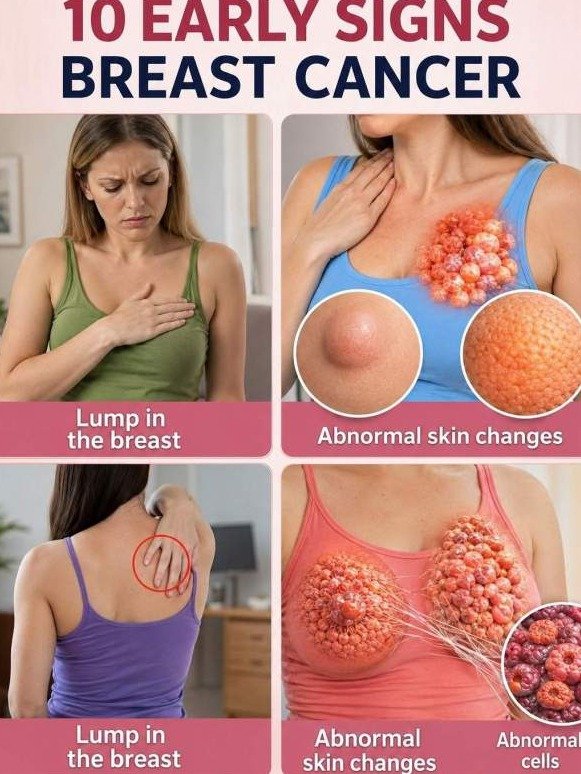
Imagine a garden hose with an unseen kink: water continues to flow, but the pressure is altered, its shape changes, and the problem becomes visibly apparent at the point of obstruction. Breast tissue operates on a similar principle: once its delicate internal structure is compromised or altered, the external surface inevitably begins to reveal the story of what is happening within.
This is precisely why a persistent rash around the nipple, a new crusty patch, or an unexplained one-sided change in breast size demands immediate attention, even in the complete absence of pain. Breast cancer doesn’t always announce itself with a clamor; sometimes, it’s the subtle, silent force meticulously rearranging the entire room while everyone’s attention is diverted elsewhere.
And certainly, many breast changes can be attributed to hormonal cycles, benign cysts, or other harmless growths. But here is the critical insight that should command your full attention: frequently, the sole distinguishing clue you will receive is the subtle yet profound difference between what is ‘normal for me’ and what is ‘not normal for me.’
Therefore, the true essential skill isn’t to succumb to panic. It is, unequivocally, the mastery of pattern recognition.
What Early Awareness Actually Changes
When women truly understand their unique baseline, they become acutely attuned to subtle, unusual details much more quickly—whether it’s a lump that was undeniably absent last month, skin that suddenly resembles a wrinkled orange peel, or an unexpected fullness in the underarm area that feels like a hidden marble. This heightened awareness transforms vague, gnawing dread into decisive, empowered action.
Beyond the physical, this knowledge fundamentally alters the emotional landscape of your entire day. Instead of endlessly replaying the same anxious worries in your mind, you transition from a nebulous ‘something feels off’ to a clear, confident declaration: ‘I understand what I’m observing, and I know precisely what steps to take next.’ That profound shift alone can feel as liberating as flinging open a window in a room that has felt suffocating for weeks.
Your body responds with a different kind of relaxation when you cease the constant guessing game. Even the deceptively simple act of meticulously checking your breasts in the mirror, with arms raised to fully expose all skin surfaces, can bring to light crucial details that a hurried morning routine would inevitably miss.
This is precisely where genuine relief truly begins. It doesn’t stem from a naive pretense that every change is benign, but rather from an unwavering refusal to allow any silent, internal shift to remain hidden and unaddressed.
Implementing a consistent monthly self-check, initiating a prompt discussion with a healthcare professional, and fostering a resolute willingness to acknowledge persistent changes as genuinely significant can collectively transform unsettling uncertainty into a concrete, actionable plan. This is the often-understated benefit that deserves far more recognition: awareness doesn’t cultivate fear; instead, it empowers you with invaluable leverage.
The One Habit That Catches the Quiet Changes
To truly catch these quiet, vital changes, adopt a methodical approach: position yourself before a mirror and meticulously examine both breasts for any signs of asymmetry. Then, lie down and, using the flat pads of your fingers, systematically explore the breast tissue in slow, circular motions, extending this examination to the underarm area, noting anything new or unusual. Always compare each side, as your unique body serves as the only truly relevant baseline.
However, here lies a common pitfall: performing this crucial self-examination when you’re half-awake, immediately after a hot shower, or simply rushing through the motions can inadvertently obscure the very subtle changes you are striving to detect. Think of it this way: breast tissue demands to be inspected with the meticulous focus of a detective scrutinizing a crime scene, not with the hurried, distracted glance one gives a crumpled receipt.
The subsequent layer of this practice is even more critical, largely because a pervasive, common habit can render the entire self-examination process fundamentally unreliable…
Consistently employing the same distracted routine each month, often in a less-than-alert state, can effectively conceal the very lump or skin alteration you desperately need to identify. A far more effective strategy involves conducting your self-check when you are genuinely able to compare, feel, and observe with absolute clarity—a practice that will make those subtle differences stand out even more rapidly.
Please note: This article is provided strictly for informational purposes and should not be considered a substitute for professional medical advice. Always consult with your healthcare provider for personalized medical guidance and diagnosis.