 By admin
 Imagine this: one wrong step, a sudden twist, or a bad landing, and then… a distinct “pop” inside your knee. In that split second, your world might just shift. What if that sound signals something far more serious than a simple sprain? It could be an Anterior Cruciate Ligament (ACL) tear, an injury that impacts more than just temporary pain.
The encouraging news is that with prompt medical attention, a well-structured rehabilitation plan, and a good dose of patience, countless individuals successfully navigate their recovery and return to walking, exercising, and fully embracing their daily routines once more.
Important note: This article is intended solely for educational purposes and should not be considered a substitute for professional medical advice, diagnosis, or treatment.
What Exactly Is the ACL and Why Is Its Role So Critical?
The Anterior Cruciate Ligament (ACL) stands as one of the primary stabilizing components nestled deep within your knee joint. This vital ligament acts as a crucial connector between your thigh bone (femur) and your shin bone (tibia), playing a significant role in governing forward motion and ensuring rotational stability.
When the ACL lacks sufficient integrity or support, the knee can feel noticeably less stable, particularly during movements like turning, running, jumping, or making quick changes in direction.
Its essential functions encompass:
✅ Preventing the tibia from shifting too far forward
✅ Providing crucial rotational control for the knee
✅ Contributing significantly to overall balance during physical activity
✅ Enhancing the comprehensive stability of the joint
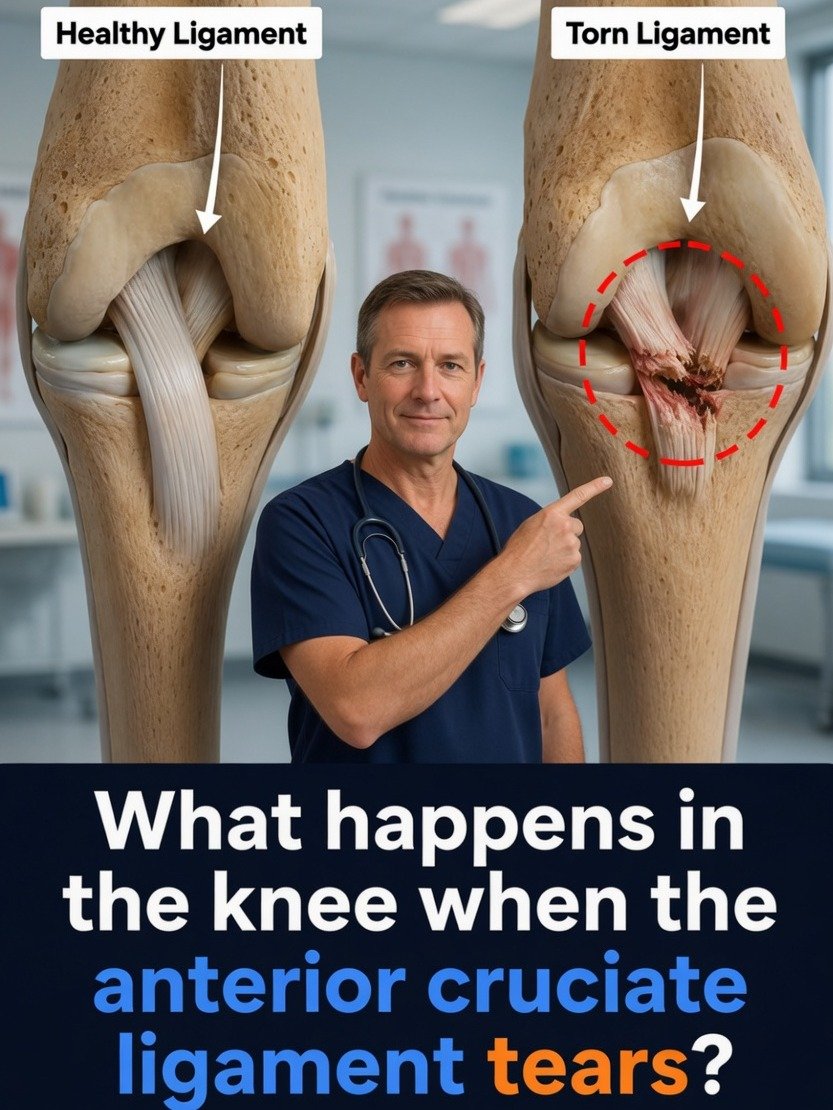
When this indispensable ligament becomes overstretched, partially torn, or completely ruptured, the knee’s normal function can be severely compromised.
An ACL injury is far more complex than just experiencing a bit of pain.
Once the injury occurs, several significant changes can rapidly unfold within the joint:
1. Ligament Fibers Undergo Stretching or Tearing
The ACL is composed of robust, interconnected connective tissue fibers. During the traumatic event:
- Mild injuries might only involve a stretching of these fibers.
- Moderate injuries often result in partial tears within the ligament.
- Severe cases can lead to a complete rupture, where the ligament separates entirely.
When the ligament fully detaches, the knee’s inherent stability may diminish dramatically.
2. Internal Swelling Can Develop Rapidly
Many individuals report noticing significant and swift swelling within mere hours following the injury.
This common reaction typically occurs because the surrounding tissues become irritated, and small, delicate internal blood vessels can be damaged, leading to fluid accumulation.
Observable indicators may include:
- Visible knee swelling
- A sensation of warmth around the joint
- Increased stiffness
- Restricted range of motion
3. Stability of the Joint May Drastically Change
Interestingly, some individuals can still manage to walk after sustaining an ACL tear, which can sometimes lead to confusion about the severity of the injury.
Because the experience of pain varies widely among people, the injury might initially seem less serious than it truly is.
However, as the days progress, everyday activities such as:
- Making quick turns
- Descending stairs
- Running at any pace
- Pivoting movements
may begin to feel considerably more challenging or precarious.
Many describe the disconcerting sensation of the knee simply “giving way” unexpectedly.
Understanding the Common Causes of ACL Tears
ACL injuries are frequently sustained during physical activities that involve:
🏃 Abrupt changes in direction
⚽ Sudden, forceful stops
🏀 Dynamic jumping and landing maneuvers
⛷ Complex rotational movements
Some sports particularly prone to ACL injuries include:
- Soccer
- Basketball
- Skiing
- Handball
- Tennis
However, it’s crucial to remember that athletes are not the sole individuals susceptible to these injuries.
Even routine daily situations can contribute to an ACL tear, such as:
- Slipping unexpectedly on wet or slick surfaces
- Misjudging or missing a step on a staircase
- Executing sudden, uncontrolled twisting movements
- Experiencing a fall
Early Symptoms You Should Never Ignore
While symptoms can vary from person to person, certain common indicators may emerge almost immediately:
A distinctive popping sound or sensation
Many individuals vividly recall hearing a sharp, sudden “pop” at the precise moment of injury.
Rapid onset of swelling within hours
The affected knee often becomes visibly enlarged and puffy quite quickly.
Noticeable reduction in movement
Attempting to bend or straighten the knee may feel restricted or painful.