 By admin
 Beyond the Ache: Distinguishing Joint, Muscle, and Ligament Pain
You stand up from the couch and a familiar ache flares in your knee or shoulder. Is it just age, a bit of stiffness, or something more? Many adults grapple with this confusion, unable to pinpoint whether the discomfort stems from a joint, a muscle, or a ligament. Each type of pain presents unique clues, and misunderstanding them can inadvertently worsen your condition.
The good news? Your body often provides subtle hints. Learning to recognize these can empower you to make smarter daily choices. By the end of this article, you’ll uncover a simple diagnostic rule many healthcare professionals use to quickly identify the source of pain.
Understanding Joint Pain
Joint pain manifests where two bones connect, commonly in areas like the knees, shoulders, hips, and elbows. These critical junctions house cartilage, fluid, and soft tissues that enable smooth motion. When these structures are irritated, the discomfort often feels deep-seated, as if ‘inside the bone,’ rather than superficial.
Typical signs of joint pain, frequently observed in older adults, include:
- A deep, persistent ache that feels internal
- Morning stiffness that gradually eases with movement
- Pain triggered or worsened by specific movements like walking or climbing stairs
- Mild, sometimes visible, swelling around the joint
Health research from organizations like the Arthritis Foundation indicates that joint discomfort becomes more prevalent with age, primarily due to the gradual loss of cartilage elasticity and fluid balance. Unlike other pains, joint pain often develops slowly, persisting for months or even years. Common culprits include:
- Age-related cartilage wear and tear
- Inflammation within the joint capsule
- Long-term strain from repetitive activities
- Reduced overall joint mobility
However, it’s crucial not to assume all pain near a joint is necessarily joint pain. This common misconception often leads to missteps in self-care.
Understanding Muscle Pain
Muscle pain typically originates from the muscles surrounding a joint, not the joint itself. If you’ve ever overdone it with gardening, heavy lifting, or a new workout, you’re familiar with the delayed soreness that follows. This is a classic example of muscle discomfort.
Unlike joint pain, muscle pain is generally easier to localize with your fingers. Key indicators include:
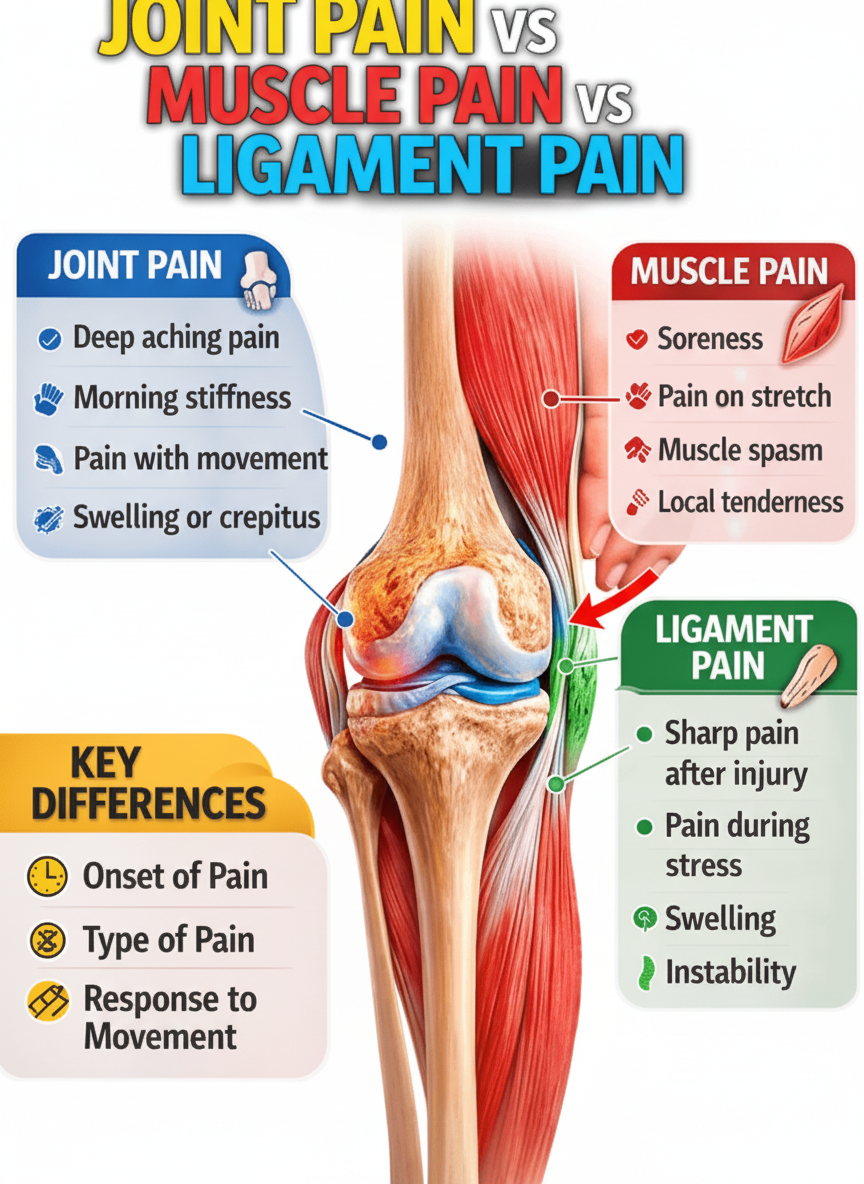
- Soreness or tightness in a specific muscle group
- Pain when stretching or contracting the affected muscle
- Temporary muscle cramps or spasms
- Tenderness upon pressing the muscle
Interestingly, muscle pain often appears after activity, not before. Sports medicine studies frequently refer to this as delayed onset muscle soreness (DOMS), which typically surfaces 12 to 48 hours post-exertion. Furthermore, muscle pain usually improves with gentle movement, stretching, and rest, whereas joint pain might worsen with heavy use – a critical distinction for self-diagnosis.
Understanding Ligament Pain
Ligaments are robust bands of fibrous tissue that connect bone to bone, providing stability to joints and preventing excessive movement. When a ligament is stretched beyond its capacity or subjected to sudden force, pain can emerge rapidly. This is why ligament pain often begins immediately after an awkward movement or a minor injury.
Common signs of ligament involvement include:
- Sharp, immediate pain following a twist or fall
- Discomfort when the joint is bearing weight or under pressure
- Swelling localized around the joint area
- A sensation that the joint feels unstable or weak
While athletes frequently experience ligament injuries in the knees or ankles, everyday mishaps can also trigger them, such as slipping on wet floors, stepping awkwardly off a curb, or twisting a knee while turning. What’s often surprising is that even minor ligament strains can cause lingering discomfort for weeks, primarily because these tissues receive less blood supply than muscles, leading to slower healing. Consequently, careful movement and patience are paramount during recovery.
The Crucial Differences Most People Miss
Many adults struggle to differentiate these types of pain because they often occur in similar anatomical regions. The simplest way to distinguish them is by observing three key clues: onset, sensation, and reaction to movement.
Here’s a simple rule, often used by family doctors, to quickly narrow down the possibilities:
- Joint Pain: Presents as a deep, persistent ache (sensation) that often worsens with movement (reaction) and develops gradually over time (onset).
- Muscle Pain: Feels like a localized soreness or tightness (sensation) that appears 12-48 hours after activity (onset) and typically improves with gentle movement and rest (reaction).
- Ligament Pain: Is characterized by sharp, immediate pain (sensation) right after an awkward movement or injury (onset), often accompanied by a feeling of instability, and may worsen with pressure on the joint (reaction).
By paying close attention to these distinctions, you can gain a clearer understanding of your body’s signals and take more informed steps towards relief and recovery.