 By admin
 Do You Really Know Your Teeth? The 4 Types Protecting Your Smile
Many adults, despite years of diligent brushing, don’t truly understand the specific jobs of their teeth. This lack of awareness often leads to habits that inadvertently damage their smile. When chewing becomes uncomfortable or food gets consistently stuck, it’s easy to blame age, but understanding your teeth’s unique design is actually key to preventing many common problems.
The good news? Learning about the four main types of teeth and their vital roles makes protecting your smile significantly easier. Stick around, because by the end of this article, I’ll reveal a surprisingly simple habit many dentists quietly wish everyone practiced daily.
Incisors: Your Front Teeth for Cutting
The first teeth you see when you smile are your incisors – the eight flat, thin teeth positioned at the very front of your mouth (four on top, four on the bottom). Their essential job is straightforward: cutting food into manageable pieces, much like precision scissors. Think of biting into an apple or a sandwich; your incisors perform that crucial initial slicing.
However, incisors are thin and sharp, meaning they are not designed for heavy, forceful pressure. Misusing them can lead to gradual weakening and chipping, which is a common dental issue. To protect them, avoid these habits:
- Opening plastic packaging or tearing tape
- Biting fingernails
- Cracking hard seeds or nuts with your front teeth
- Using them to hold objects like pins or bottle caps
These actions exert unnecessary stress on teeth built exclusively for cutting. But incisors are just the beginning; right beside them are teeth engineered for a much stronger purpose.
Canines: The Strong Teeth for Tearing
Flanking your incisors are the four pointed canines (two on the upper jaw, two on the lower). Their specialized role is tearing tougher foods. Historically, these robust teeth were vital for early humans to tear into meat and fibrous plants; today, they remain an important part of efficient chewing.
Canines are among the strongest anchored teeth in your mouth, boasting longer roots deeply embedded in the jawbone. This deep anchorage provides crucial stability for your entire bite. Dentists often regard canines as key alignment anchors when assessing how your upper and lower teeth meet.
Their key functions include:
- Efficiently tearing fibrous and tough foods
- Guiding the jaw’s movement during chewing, ensuring proper bite alignment
- Helping to stabilize adjacent teeth
Despite their strength, this resilience can sometimes tempt people into misuse. Many adults unconsciously develop habits like tearing open snack bags or plastic with their canines. Over time, such actions can lead to significant enamel wear and even structural damage. Remember, even strong teeth are still biological structures, not multi-tools.
Premolars: The Crushers for Digestion
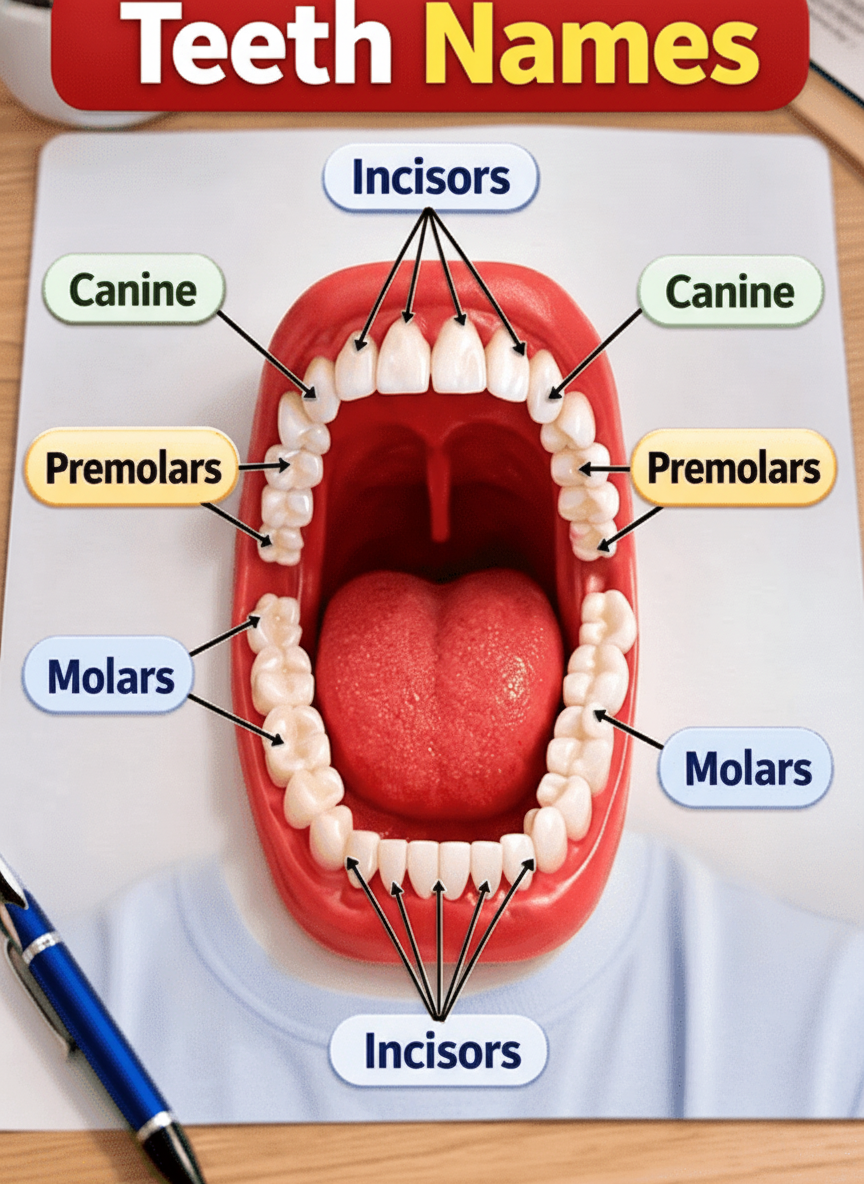
Positioned between your canines and the larger molars sit your eight premolars (four on top, four on the bottom). With their unique shape, featuring flatter surfaces equipped with small ridges called cusps, premolars are perfectly designed for crushing and grinding food into progressively smaller pieces. They represent the crucial intermediate stage of the chewing process:
- First, incisors cut.
- Then, canines tear.
- Finally, premolars begin the vital work of crushing.
This crushing stage is profoundly important for efficient digestion; nutritional research confirms that properly broken-down food allows your stomach and intestines to process nutrients much more effectively. Conversely, rushed or inadequate chewing forces your digestive system to work harder, potentially leading to discomfort or reduced nutrient absorption.
Many older adults notice that if their premolars become worn down or overly sensitive, they often begin favoring one side of their mouth for chewing. This imbalance can gradually impact jaw comfort, chewing patterns, and even overall oral health. Ensure they get the attention they deserve.
Molars: The Powerhouses for Final Grinding
At the very back of your mouth reside the molars – the true powerhouses of your chewing system. Most adults have eight molars (two sets of upper and lower, four on each side), plus up to four wisdom teeth (third molars) that may or may not erupt. Molars are the largest and strongest teeth, characterized by their broad, flat surfaces and multiple cusps, perfectly designed for the final, intensive grinding and pulverizing of food into a swallowable, digestible paste.
Their robust structure is essential for the final breakdown of food, ensuring maximum surface area for digestive enzymes to act upon and optimal nutrient absorption. Because of their location deep at the back of the mouth, molars are often more challenging to clean thoroughly, making them particularly susceptible to plaque buildup and cavities. Regular and meticulous brushing, especially reaching these back teeth, along with consistent flossing, is paramount to maintaining their health and function.
Protecting Your Smile: The Simple Secret
Understanding the unique roles of your incisors, canines, premolars, and molars is the first crucial step toward lifelong oral health. Each tooth type plays a specific, irreplaceable part in the complex symphony of chewing and digestion. Misusing them, even unintentionally, can lead to premature wear, damage, and discomfort that impacts your overall well-being.
So, what’s that surprisingly simple habit many dentists wish more adults practiced daily? It’s not a new expensive gadget or a complex technique. It’s simply flossing every single day. Flossing reaches where your toothbrush can’t, removing plaque and food particles from between your teeth and under the gum line. This prevents cavities and gum disease that compromise the very foundations of your smile.
This small, consistent effort, combined with understanding and respecting your teeth’s natural functions, will empower you to protect your smile effectively for years to come. Your teeth work hard for you; understanding them helps you work smarter for them.