 By admin
 Our hands are more than just tools; they’re often silent storytellers of our inner health. Many of us might notice subtle changes—a strange nail shape, palms suddenly flushing red, or a finger gradually bending—and initially dismiss them as harmless. Yet, these seemingly minor alterations can be crucial early warnings from your body. Learning to interpret these subtle cues can empower you to identify potential health issues sooner. Stick around, because towards the end of this article, I’ll share a quick, one-minute self-check you can do right at home.
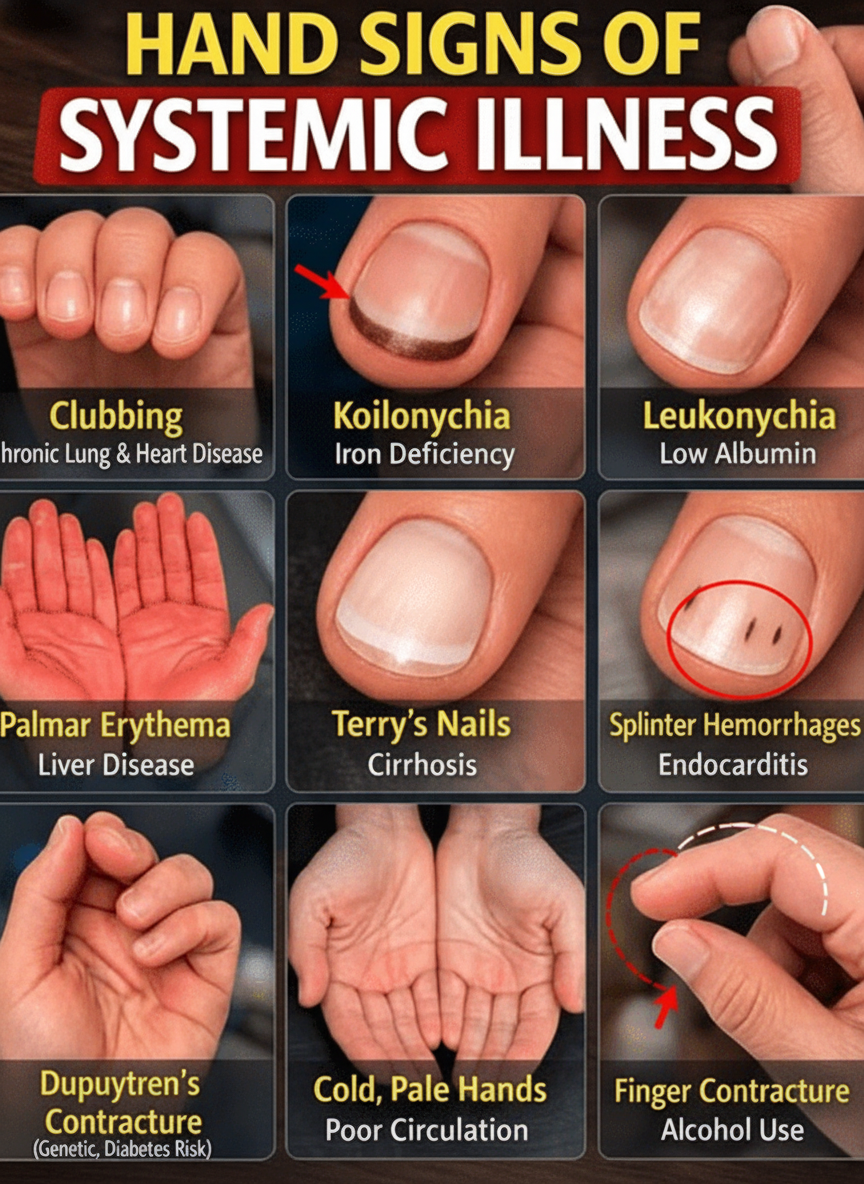
Clubbing Fingers: What Round, Bulging Fingertips Mean
Have you ever noticed your fingertips becoming unusually round and thick, with nails that curve downwards, making the tips appear slightly swollen? This distinctive change is medically known as clubbing. Esteemed medical institutions like the Cleveland Clinic and MedlinePlus indicate that clubbing often arises from prolonged periods of low oxygen in the body. It can be a tell-tale sign of underlying conditions, including:
- Chronic lung diseases
- Specific heart conditions
- Digestive or liver disorders
Intriguingly, clubbing typically develops so gradually that many individuals don’t notice it until a family member points it out. To perform a quick home check:
Press the nails of both index fingers together. If a small, diamond-shaped gap forms between the nails, your finger shape is likely normal. However, if this gap disappears, it’s sometimes referred to as the Schamroth sign, which may suggest clubbing. While this simple observation isn’t a diagnosis, it serves as a valuable indicator to consult a medical professional.
Spoon-Shaped Nails (Koilonychia): A Dip in Health?
Take a moment to examine your fingernails. Do they curve inward, resembling a small spoon, rather than maintaining their natural outward arch? This distinctive pattern is called koilonychia, or more commonly, “spoon nails.” Often, this sign is closely associated with insufficient iron levels in the body. Iron is vital for producing healthy red blood cells, and a deficiency can compromise nail structure, leading to this characteristic shape. Other potential factors contributing to spoon nails include:
- General nutritional deficiencies
- Specific digestive conditions
- Prolonged exposure to certain chemicals
However, it’s important to note that for older adults, spoon nails can also be a benign consequence of natural aging processes affecting nail growth. This underscores why healthcare professionals always consider your complete health profile, rather than focusing solely on nail appearance, when making an assessment.
White Spots on Nails (Leukonychia): More Than Just Calcium
Those small white marks you might find on your nails? Many assume they signal a calcium deficiency, but the truth is often far simpler. These spots, medically termed leukonychia, most commonly arise from:
- Minor trauma or injury to the nail
- Pressure from frequent manicures
- Temporary disruptions in nail growth
However, if you observe white lines appearing across several nails simultaneously, doctors may investigate other potential causes, such as fluctuations in blood protein levels. Dermatological research consistently highlights how nail appearance—including color and texture—can offer insights into overall health. This is precisely why physicians often include a nail examination during routine checkups. Therefore, if these spots emerge suddenly across multiple nails or persist for an extended period, it’s advisable to discuss them with your doctor during your next visit.
Red Palms (Palmar Erythema): A Flush of Concern?
Have you ever noticed your palms taking on a distinct bright red hue, particularly around the thumb and little finger? This phenomenon is known as palmar erythema. The redness is caused by the widening of tiny blood vessels close to the skin’s surface and can manifest during:
- Pregnancy
- Significant hormonal shifts
- Specific liver-related conditions
On a reassuring note, palmar erythema isn’t always indicative of a serious problem. Often, it can simply be linked to benign circulatory changes or even genetics. Nevertheless, any persistent redness that appears abruptly warrants evaluation by a healthcare professional to rule out underlying issues.
Terry’s Nails: When White Dominates the Nail
Among the various nail patterns, Terry’s nails present a distinct appearance: the majority of the nail bed turns white, leaving only a narrow, darker band at the very tip. This pattern is occasionally observed in individuals grappling with chronic health conditions, notably liver or heart disorders. However, it’s also crucial to understand that the aging process itself can alter nail coloration.
For this reason, medical specialists never base a diagnosis on a single visual sign. Instead, they meticulously integrate findings from physical examinations, blood tests, and a comprehensive review of medical history to form a complete and accurate health picture.
Splinter Hemorrhages: Tiny Dark Lines Beneath the Nail
Spotting thin, reddish-brown lines beneath your fingernails, reminiscent of tiny wood splinters? These are called splinter hemorrhages. They occur when minute blood vessels directly under the nail plate rupture, causing small streaks of blood to become trapped.