 By admin
 Baking Soda for Pest Control: A Safe and Natural Approach to Managing Roaches, Ants, and Mice
Discovering unwanted guests like roaches, ants, or mice scurrying through your home can quickly transform a peaceful sanctuary into a source of considerable stress. Despite your best efforts—regular cleaning, meticulous food storage, and diligent maintenance—these common household pests often find their way in. The frustration is compounded by the fact that many commercial pest control products can be harsh, costly, or simply overwhelming to use. Fortunately, a common household staple, baking soda, offers a natural and potentially safer alternative for managing minor pest issues. This comprehensive guide will reveal how to effectively integrate baking soda into your pest management strategy, highlighting crucial details often missed by others.
Understanding Baking Soda’s Role in Natural Pest Management
Baking soda, chemically known as sodium bicarbonate, is a versatile compound found in nearly every kitchen, prized for its applications in baking and cleaning. Beyond these uses, it has gained popularity as an affordable, natural option for tackling specific household pests. The underlying principle is quite straightforward: when certain insects consume baking soda, it interacts with the moisture and acids present in their digestive systems, leading to the production of gas. Theoretically, this internal gaseous reaction can disrupt their bodily functions and contribute to their demise. For rodents, the theory suggests that ingesting a sufficient quantity of baking soda could cause internal distress, as they are unable to expel gas effectively.
It is crucial, however, to approach these claims with realistic expectations. Scientific research specifically validating baking soda as a primary or standalone pest control method is quite sparse. While some controlled laboratory observations and various anecdotal accounts indicate it may have an impact under specific conditions, it is generally not recognized as a guaranteed or comprehensive solution for significant pest infestations. Instead, baking soda is best viewed as a complementary tool within a broader, integrated pest management strategy, requiring careful and informed application—a point where many often falter.
Targeting Specific Pests: How Baking Soda Interacts with Roaches, Ants, and Mice
It’s important to recognize that not all household pests will react similarly to baking soda. Understanding these distinctions is crucial for applying any method effectively and avoiding wasted effort.
Cockroaches
Cockroaches are primarily lured by accessible food sources rich in sugars or starches. Baking soda by itself typically holds little appeal for them. To transform it into an attractive bait, it’s commonly blended with sweet or starchy ingredients:
- Equal parts baking soda and granulated sugar
- Equal parts baking soda and confectioners’ sugar
- Baking soda combined with flour
The added sugar or flour acts as a potent attractant, encouraging roaches to consume the mixture. Once ingested, some smaller-scale studies and discussions within pest control circles suggest that the internal reaction can lead to pressure from gas accumulation within the roach. However, a critical point to remember is that this approach generally yields slow results and is highly unlikely to eradicate a substantial roach infestation.
Ants
Ants are known for their highly organized colonies and their reliance on distinct scent trails to locate food. They are particularly attracted to sugary substances. A widely adopted home remedy involves:
- Mixing baking soda with powdered sugar
- Distributing the blend along active ant trails
- Placing it strategically near known entry points
While worker ants might carry small quantities of this mixture back to their colony, it’s important to note that baking soda combinations are generally less effective than specialized ant baits designed to reach and eliminate the queen. For minor, seasonal ant activity, however, this method can sometimes help in reducing the visible ant population.
Bedbugs – A Crucial Distinction
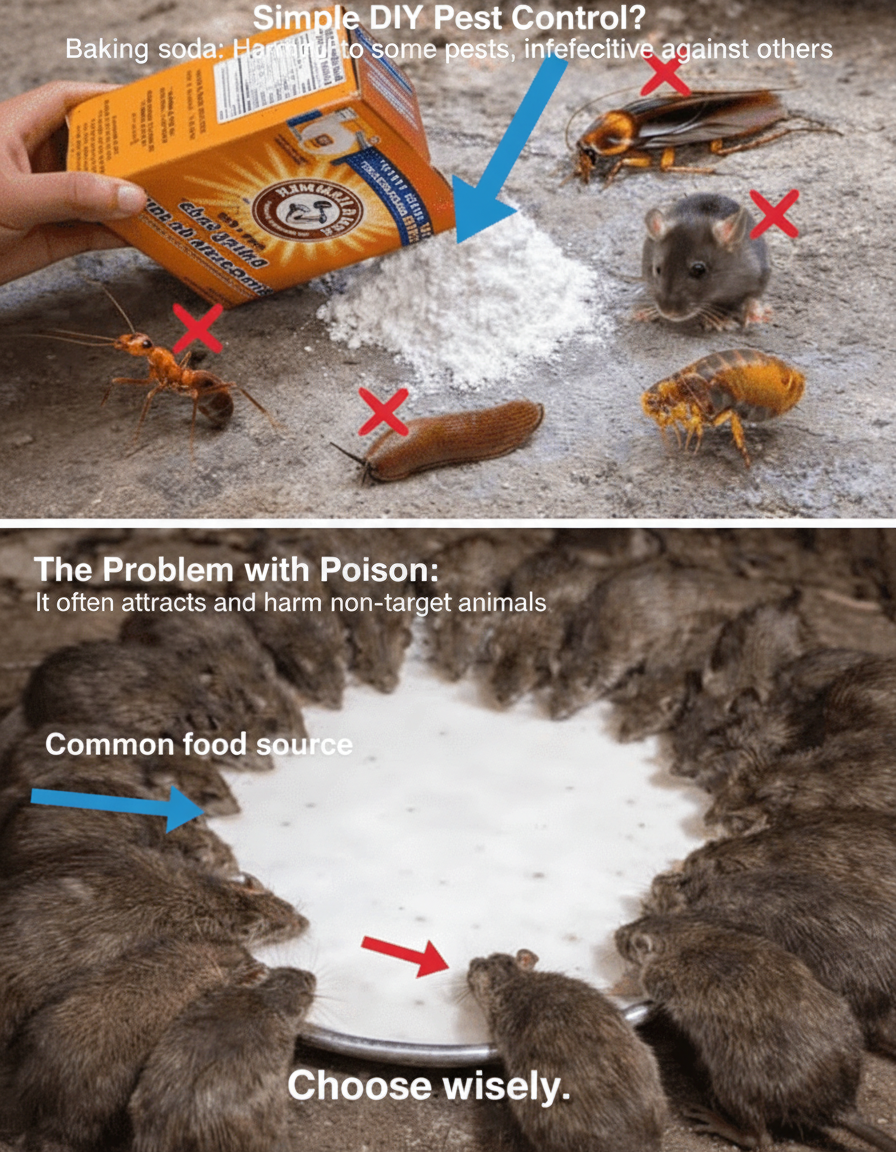
Bedbugs are parasitic insects that feed exclusively on blood; they are not drawn to sugar or dry powders like baking soda in the same manner as roaches or ants. Despite widespread claims found online, there is virtually no scientific evidence to support the effectiveness of baking soda in controlling bedbug infestations. While sprinkling baking soda on mattresses or carpets might temporarily absorb some moisture, it does not address the core problem of a bedbug infestation. Relying solely on baking soda for bedbugs can be detrimental, as it often delays the implementation of truly effective interventions, allowing the infestation to worsen.
Mice
The idea that baking soda can deter mice stems from the fact that rodents, unlike humans, cannot easily expel gas. The theory posits that ingesting baking soda could lead to significant internal discomfort. Nevertheless, mice are inherently cautious eaters, often wary of unfamiliar substances. Without a strong, compelling attractant, it’s improbable that mice would consume enough pure baking soda to experience any significant effect. Furthermore, when compared to established professional rodent control methods, the efficacy of baking soda is considerably less predictable. Therefore, for managing mice, baking soda should be considered a supplemental measure rather than a primary solution for anything beyond the most minor, isolated issues.
A Practical Guide: Using Baking Soda for Minor Household Pest Issues
Should you choose to incorporate baking soda into your home’s pest management strategy, here’s a cautious and practical step-by-step approach to follow:
Step 1: Accurately Identify the Pest
Prior to deploying any bait or deterrent, it is paramount to correctly identify the specific pest you are dealing with. For instance, discovering small, reddish-brown insects active primarily at night in kitchen areas often points to cockroaches. Tiny insects moving in distinct lines or trails typically signify ants. Conversely, small fecal droppings or visible gnaw marks are strong indicators of mice. Precise identification is key to ensuring your efforts are not misdirected or wasted.
Step 2: Prepare the Appropriate Mixture
When targeting common pests like roaches or ants, the recommended preparation is straightforward:
- Combine equal parts baking soda with powdered sugar.