 By admin
 It’s common for women to observe minor alterations in their breasts throughout life, but distinguishing between normal variations and potentially concerning signals can be challenging. While many changes are benign, linked to hormonal shifts or the natural aging process, some subtle differences could indicate a more serious underlying condition, such as breast cancer. Dismissing persistent or unusual changes can unfortunately postpone crucial discussions with a medical professional. Conversely, being proactive about your breast health empowers you to seek timely advice.
Leading health authorities, including the American Cancer Society and the Centers for Disease Control and Prevention (CDC), consistently highlight that early detection significantly improves treatment outcomes. This underscores the vital importance of recognizing the potential warning signs. By familiarizing yourself with these indicators, you equip yourself with knowledge that can be truly life-saving.
Understanding Your Breasts: Why Awareness Matters
Throughout a woman’s life, breasts undergo various natural transformations influenced by factors like menstrual cycles, pregnancy, menopause, and even weight fluctuations. However, certain persistent or unusual alterations might deviate from what’s typical for you. While extensive research from prominent health organizations confirms that the majority of breast changes are benign, prompt observation enables timely medical evaluation when necessary. The fundamental principle here is self-familiarity. By understanding your own body’s normal state, identifying anything out of the ordinary becomes much simpler. Initially, many women may feel apprehensive, but cultivating this habit of regular self-awareness ultimately fosters peace of mind, not anxiety.
The Impact of Early Observation: Real-Life Insights
The significance of early observation is powerfully illustrated through countless personal accounts. Take, for instance, the experience of Sarah, a 58-year-old, who noticed a subtle dimpling on her breast skin during her regular shower routine. Initially, she dismissed it as a minor skin irritation. Several months later, she brought it up during a routine physical exam. Subsequent tests confirmed an early-stage concern. “I often reflect on how much simpler things might have been if I had addressed it sooner,” she shared. Her journey underscores that even minor observations can be pivotal. These stories emphasize that while not every change signifies cancer, seeking professional clarification provides invaluable peace of mind and access to better care options.
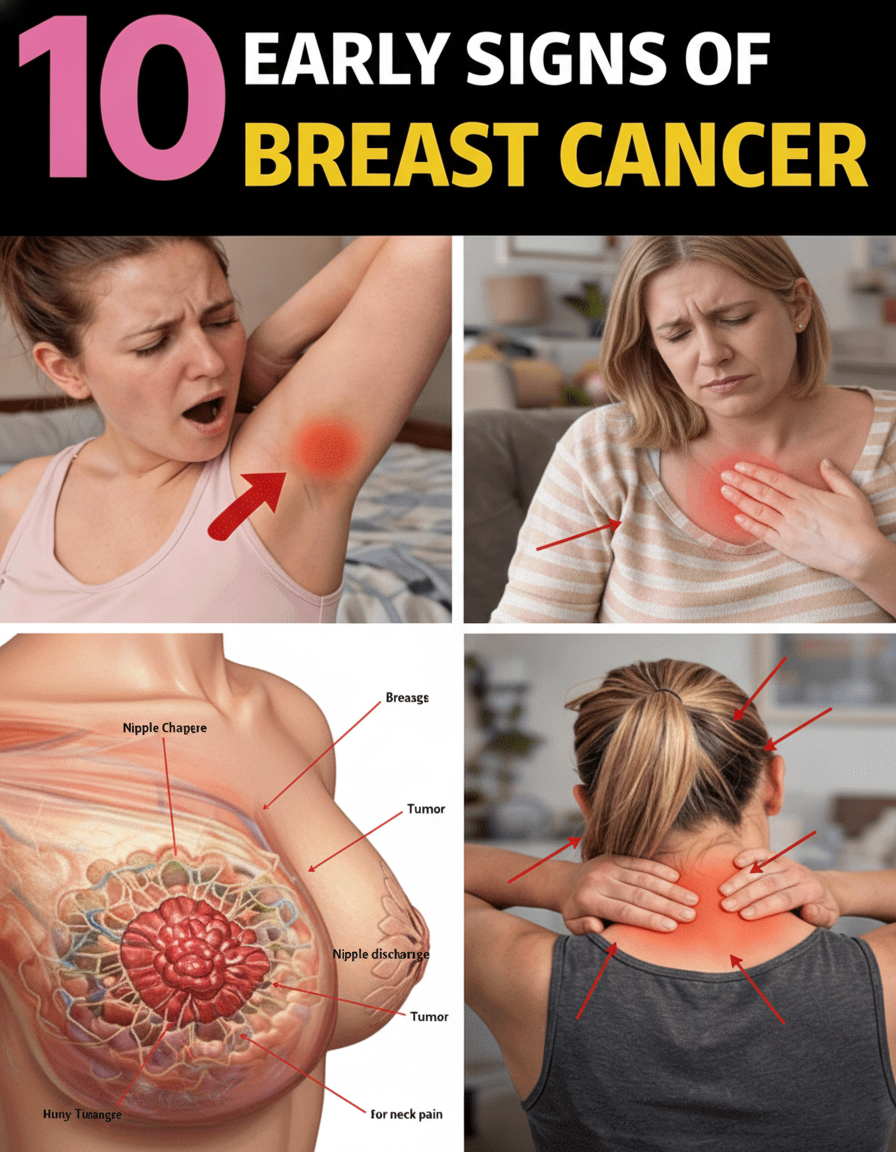
Identifying Potential Warning Signs: What Experts Advise
Leading medical institutions, including the American Cancer Society, the CDC, and the Mayo Clinic, consistently outline a set of common indicators that warrant attention. It is crucial to remember that many of these signs can also be associated with benign, non-cancerous conditions. However, the presence of any persistent or unexplained change necessitates a prompt consultation with your healthcare provider. Below is a comprehensive list of the top 10 warning signs, presented in a countdown format from less commonly discussed to the most frequently reported:
- 10. Persistent or Unexplained Breast Pain or Tenderness
While often associated with menstrual cycles or benign conditions, an enduring ache, soreness, or localized tenderness in the breast that doesn’t subside or align with your typical hormonal fluctuations should not be dismissed. Although breast cancer is frequently perceived as painless, discomfort can indeed be a symptom in certain instances. - 9. Swelling in the Armpit or Around the Collarbone Area
Enlarged or tender lymph nodes in the armpit (axilla) or above the collarbone can be a significant indicator, even if no other visible breast changes are present. This subtle swelling or feeling of fullness might initially be overlooked but warrants investigation. - 8. Nipple Retraction, Inversion, or Changes in Direction
Any new change where a nipple begins to turn inward (invert), flatten, or points in a new direction, particularly if it affects only one nipple, should be carefully observed. This alteration might develop gradually and could occur without any accompanying pain. - 7. Unusual Nipple Discharge
The appearance of spontaneous fluid discharge from a single nipple, especially if it is clear, bloody, or milky (when not breastfeeding), and occurs without squeezing or pressure, requires medical evaluation. Occasional or minor discharge might sometimes be dismissed, but persistent or unusual types should be investigated. - 6. Redness, Flaky Skin, or Thickening on the Breast or Nipple
Observe any persistent skin irritation on the breast or nipple, such as redness, flakiness, or a rash-like appearance that doesn’t respond to typical remedies like moisturizers. These changes can sometimes mimic conditions like eczema. In less common but aggressive forms, such as inflammatory breast cancer, these skin alterations can be a prominent symptom. - 5. Dimpling, Puckering, or “Orange Peel” Texture of Breast Skin
A classic visual indicator is when the skin on the breast appears dimpled, puckered, or takes on a texture similar to an orange peel (known as peau d’orange). This inward pulling or altered skin texture can initially be very subtle but warrants immediate attention. - 4. Thickening or Hardening Within Breast Tissue
Beyond a distinct lump, pay attention to any area of the breast that feels noticeably denser, firmer, or thicker than the surrounding tissue. This change in texture might not present as a clearly defined mass but can be detected during regular self-examinations. - 3. Unexplained Change in Breast Size or Shape
A noticeable and unexplained alteration in the overall size, shape, or contour of one breast compared to the other—without a clear reason such as significant weight fluctuations—can be a warning sign. Such changes might become apparent in how clothing or bras fit. - 2. Unexplained Swelling or Enlargement of the Entire Breast or Part of It
Sudden or persistent swelling affecting an entire breast or a specific region of it, sometimes accompanied by warmth or a feeling of inflammation, should be promptly evaluated. This rapid or unusual change in volume can be quite concerning. - 1. A New Lump or Mass in the Breast or Underarm Area
The most frequently reported reason individuals seek medical consultation is the discovery of a new lump or mass. This often feels hard, has irregular edges, and may or may not be painful. While the majority of new lumps are benign, any newly discovered mass in the breast or underarm warrants immediate medical assessment. Early evaluation often provides crucial reassurance or facilitates timely intervention.
Prioritizing Your Breast Health: A Call to Action
Understanding these potential warning signs is a powerful step towards safeguarding your breast health. While many of these symptoms can be attributed to non-cancerous conditions, their persistence or unexplained appearance should always prompt a visit to your healthcare provider. Don’t hesitate to discuss any concerns, no matter how minor they seem. Regular self-awareness, combined with routine clinical breast exams and recommended mammograms, forms a comprehensive strategy for early detection. Your proactive approach is key to ensuring timely diagnosis and the best possible outcomes.