 By admin
 In our hyper-connected digital world, we are immersed in an ceaseless torrent of information—from high-definition streaming and vibrant social media feeds to an endless influx of emails and critical cloud backups. It’s easy to feel overwhelmed by the sheer volume of data generated daily, and conventional storage methods, such as vast data centers and hard drives, are grappling with escalating energy demands and the sheer physical space they consume. Yet, an elegant and extraordinarily efficient solution has existed within nature all along: our own brains. The human brain masterfully processes and stores an astonishing amount of information without requiring immense power grids or sprawling physical infrastructure. What’s truly revolutionary is that scientists are now drawing profound inspiration from the brain’s intricate design, and even our very DNA, to pioneer groundbreaking ways to store data for the future, envisioning a world where the entire global digital output could fit into a space as modest as a single room.
The Astonishing Storage Power of the Human Brain
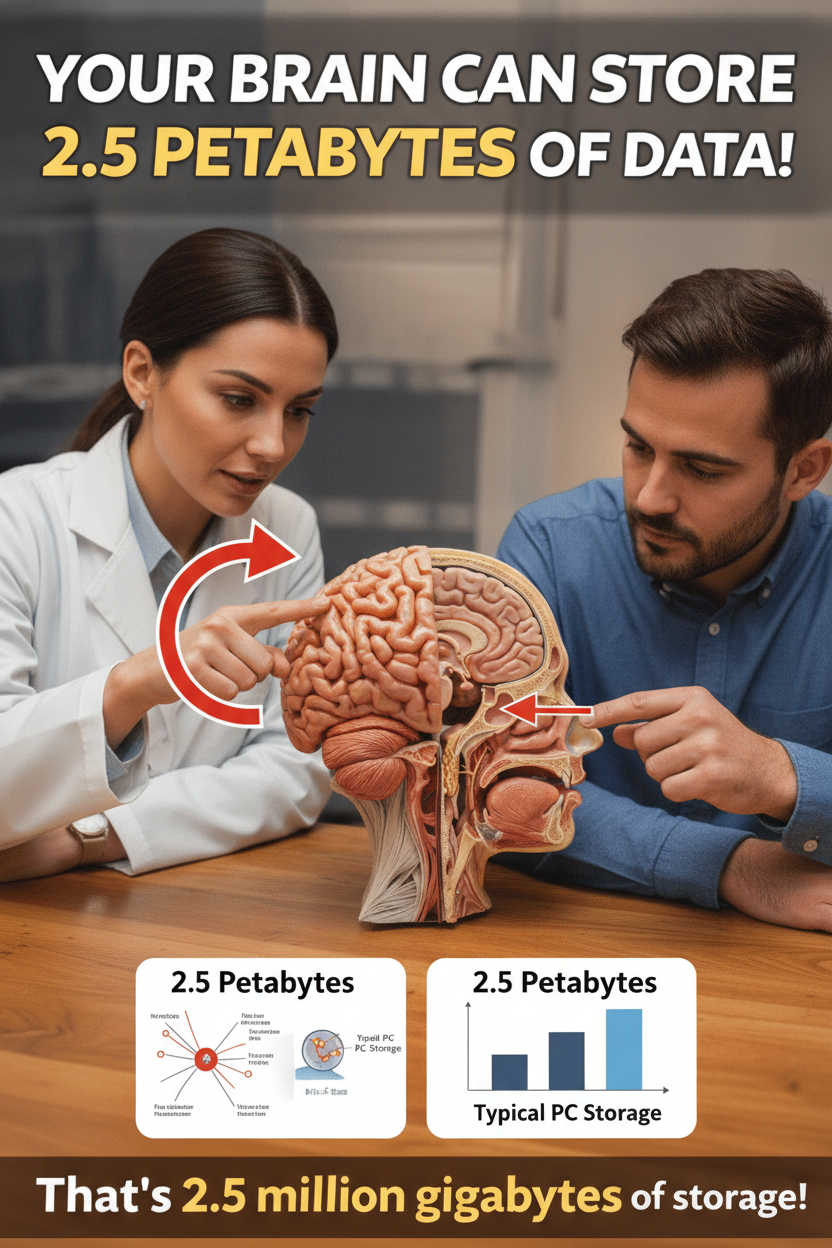
Often hailed as the most complex organ in the known universe, the human brain’s remarkable storage capacity firmly supports this claim. Current estimates suggest that an average adult brain can hold approximately 2.5 petabytes of information—a staggering figure equivalent to about 2.5 million gigabytes. To truly grasp this immense scale, consider this: if your brain functioned like a continuous digital video recorder, it could archive roughly 300 years of uninterrupted television programming or nearly three million hours of high-definition video content.
This colossal capacity stems from the brain’s unique architecture: an intricate network of roughly 86 billion neurons interconnected by over 100 trillion synapses. Each synapse functions as a microscopic, adaptable switch that can strengthen or weaken based on our experiences, enabling the brain to encode memories, skills, and knowledge with extraordinary efficiency. Research from reputable sources like Scientific American and extensive studies on synaptic plasticity corroborate this general estimate, illustrating how the brain’s dynamic and ever-changing connections facilitate far greater storage capabilities than rigid digital systems. Unlike a hard drive with fixed bits, the brain leverages variable synaptic strengths to densely pack in data while consuming surprisingly little energy—approximately 20 watts, comparable to the power usage of a dim lightbulb.
Here’s why this profound capability is significant in our daily lives:
- It elucidates our ability to retrieve childhood memories decades later while simultaneously mastering new skills on an ongoing basis.
- It underscores the brain’s inherently energy-efficient design, serving as a powerful inspiration for advancements in modern artificial intelligence and computing.
- Most importantly, it reassures us that our minds are inherently designed for continuous, lifelong learning without ever truly ‘running out of space.’
How Brain-Inspired Design Is Shaping Next-Generation Technologies
Scientists are not merely admiring the brain’s complexity; they are actively adopting its fundamental blueprint. The burgeoning field of neuromorphic computing aims to develop chips that intricately mimic neural networks, leading to significantly more efficient deep-learning systems that consume substantially less power than conventional GPUs. These brain-inspired technologies hold the potential to revolutionize everything from smarter personal devices to truly sustainable AI data centers. However, an even more profound leap in data storage lies within our very genetic code.
DNA: The Ultimate High-Density Storage Medium
While the brain’s 2.5 petabytes is undeniably impressive, DNA elevates storage density to an entirely new dimension. A mere single gram of DNA possesses the theoretical capacity to hold up to an astonishing 215 petabytes of data—enough to archive millions of movies or entire national libraries within a tiny speck of material. This isn’t a concept confined to science fiction novels.
In a seminal 2017 study published in the prestigious journal Science, researchers Yaniv Erlich and Dina Zielinski unveiled “DNA Fountain,” a groundbreaking methodology that encodes digital information directly into DNA’s four fundamental nucleotide bases (Adenine, Guanine, Cytosine, Thymine). They successfully stored a diverse range of files—including a complete computer operating system and a feature-length movie—at densities approaching the theoretical maximum, achieving flawless retrieval even after creating multiple copies. The implications of this breakthrough are truly staggering:
- Ultra-compact: The world’s projected digital data (estimated to reach hundreds of zettabytes in the coming years) could conceivably be contained within a small room filled with DNA archives.
- Long-lasting: DNA can maintain its stability and integrity for thousands of years under appropriate conditions, vastly outperforming the lifespan of magnetic tapes or traditional hard drives.
- Energy-efficient: Once digital information is written into DNA, it requires absolutely no power to maintain its stored state, a stark contrast to the continuous energy demands of massive server farms.
Naturally, significant challenges persist; synthesizing and sequencing DNA remains a costly and relatively slow process. Nevertheless, costs are declining at a rapid pace, positioning DNA storage as an incredibly promising and sustainable pathway for long-term archiving in the foreseeable future.
Brain vs. DNA Storage: A Quick Comparison
To highlight the distinct yet complementary attributes of these two incredible storage systems, consider the following:
- Human Brain Capacity: Approximately 2.5 petabytes. It’s a dynamic, active storage system designed for learning, processing, and real-time recall, operating with remarkable energy efficiency (around 20 watts).
- DNA Storage Capacity: Up to 215 petabytes per gram. It’s a passive, ultra-dense, and exceptionally long-lasting archival medium that requires no power for maintenance once data is encoded.
While the human brain offers unparalleled processing and adaptable memory for our consciousness, DNA presents an extraordinary solution for the planet’s ever-growing archival data needs, promising a future where information can endure for millennia in an incredibly compact and sustainable form.”
}
“`