 By admin
 Daily Walnut Consumption Linked to Favorable Gene Changes in Breast Tumors: A Groundbreaking Human Study
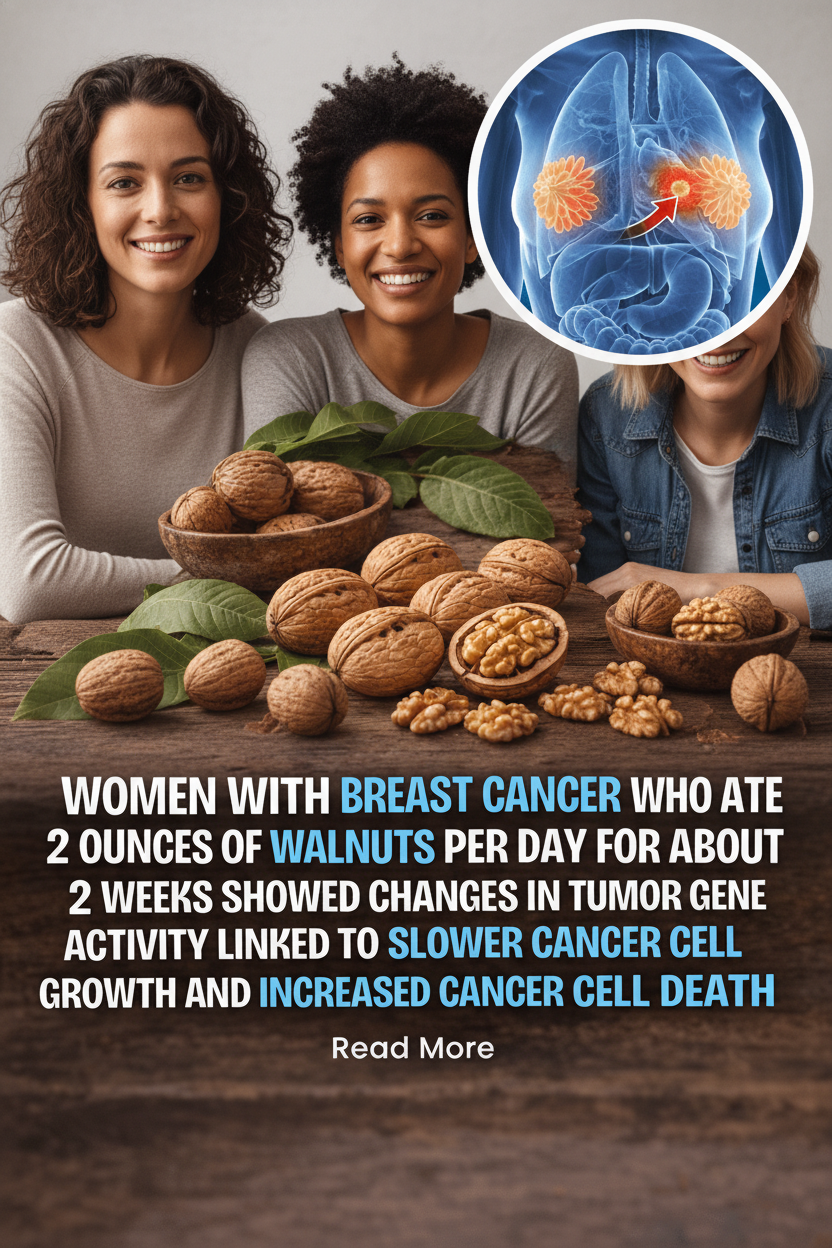
Delving into the intricate relationship between diet and disease, a significant clinical trial has shed new light on how a common whole food – walnuts – may influence breast cancer biology. Published in Nutrition Research, this pioneering study offers compelling evidence of walnuts’ potential impact at a genetic level within human breast tumors.
Groundbreaking Human Study: Eating Walnuts Daily Altered Gene Expression in Breast Tumors
In a rare and powerful clinical trial published in Nutrition Research, researchers took an innovative approach to investigate how a single whole food — walnuts — might influence breast cancer biology in real patients.
Study Design
The study design was meticulously crafted. Participants, all women recently diagnosed with pathologically confirmed breast cancer, were randomly assigned to one of two groups: either maintaining their standard diet or incorporating 2 ounces (approximately 56 grams, equivalent to about 14 walnut halves) of whole walnuts into their daily intake. This dietary intervention spanned a crucial 2-3 week period, specifically between their initial diagnostic biopsy and the subsequent surgical removal of the tumor. Importantly, no other cancer treatments, such as chemotherapy, radiation, hormonal therapy, or even dietary supplements, were administered during this observational window. This unique approach allowed each patient to serve as her own internal control, enabling researchers to directly compare tumor tissue obtained from the initial biopsy (pre-walnut consumption) with tissue from the surgical specimen (post-walnut consumption).
Key Findings from RNA Sequencing
Through sophisticated RNA sequencing and gene expression analysis, the researchers uncovered profound molecular changes. A remarkable 456 genes within the breast tumors of the walnut-consuming group exhibited significant alterations when contrasted with the control group. Further pathway analysis painted a clear picture of a favorable shift in tumor biology:
- Activated pathways: Key pathways promoting Apoptosis (programmed cell death) and enhanced cell adhesion were notably upregulated.
- Suppressed pathways: Conversely, pathways associated with undesirable cellular activities like cell proliferation (rapid growth), inflammation, cellular migration, angiogenesis (the formation of new blood vessels that feed tumors), and metastasis (the spread of cancer) were significantly downregulated.
Furthermore, several critical signaling cascades implicated in cancer progression demonstrated modulation, including:
- Estrogen receptor signaling
- PI3K/Akt pathway
- ERK pathway
- VEGF (vascular endothelial growth factor) pathway
- Various inflammatory cascades
Collectively, these compelling molecular shifts strongly suggest that even a relatively short period of daily whole walnut consumption can actively steer human breast tumor tissue towards outcomes characterized by reduced growth, diminished survival capabilities, and a decreased propensity for spread. This remarkable effect was observed even without the concurrent application of any conventional cancer therapies during the study’s duration.
Why This Study Stands Out
This particular study distinguishes itself significantly from the majority of dietary cancer research, which often depends on animal models, isolated cell lines, or broad observational epidemiological data. Its exceptional nature stems from several critical aspects:
- Direct Human Tissue Analysis: It utilized actual human breast tumor tissue, collected both before and after the dietary intervention, providing highly relevant insights.
- Patient as Control: Each participant effectively served as her own control, a powerful design that inherently minimizes numerous confounding variables often present in other study designs.
- Whole Food Intervention: The intervention involved simply adding a whole, unprocessed food – walnuts – to the participants’ regular diet, rather than relying on isolated compounds, extracts, or pharmaceutical drugs.
- Molecular-Level Evidence: Crucially, it demonstrated direct, quantifiable changes at the fundamental gene-expression level within genuine cancer tissue, offering a deep understanding of the biological impact.
Important Context & Limitations
While these findings are highly encouraging, it is essential to consider the study’s context and inherent limitations. The trial was relatively small in scale and short in duration (2-3 weeks). Therefore, it primarily establishes biological plausibility and elucidates mechanistic effects rather than demonstrating long-term survival benefits. Furthermore, while walnuts are a nutrient-dense food, rich in healthy fats, they should be viewed as a supportive dietary component, not a standalone treatment or a substitute for conventional medical care. The observed results pertain specifically to women awaiting surgery for newly diagnosed breast cancer and do not, at this stage, definitively prove preventative effects or a cure for other stages or types of cancer.
Practical Takeaway for Most People
In conclusion, while this research does not assert that “walnuts cure breast cancer,” it undeniably offers compelling evidence that a moderate daily intake of whole walnuts (approximately 56 g / 2 oz) can trigger beneficial gene-expression alterations within breast tumors. Specifically, it supports processes like apoptosis (programmed cell death) while actively suppressing pathways involved in cell proliferation, inflammation, and metastasis. For individuals seeking to enhance their general health, integrating 1-2 ounces (approximately 28–56 g) of walnuts into their diet most days is a low-risk, nutrient-rich habit. This practice is widely supported by numerous large-scale studies, which link walnut consumption to improved cardiovascular health, better metabolic outcomes, and significant anti-inflammatory benefits. Crucially, if you or someone you know is navigating a breast cancer diagnosis, always prioritize and adhere to the expert guidance of your oncology team. Dietary interventions, including walnuts, serve as a complementary approach and should never be considered a replacement for established, proven medical treatments.
Share facebook Share on Facebook twitter Share on Twitter pinterest Share on Pinterest Share More More + linkedin Share on Linkedin vk Share on Vk reddit Share on Reddit tumblr Share on Tumblr viadeo Share on Viadeo buffer Share on Buffer pocket Share on Pocket whatsapp Share on Whatsapp viber Share on Viber email Share on Email skype Share on Skype digg Share on Digg myspace Share on Myspace blogger Share on Blogger YahooMail Share on Yahoo mail telegram Share on Telegram Messenger Share on Facebook Messenger gmail Share on Gmail amazon Share on Amazon SMS Share on SMS
Related Posts
Categories Healthy Life How to Remove Skin Tags in One Night Naturally at Home (Best Vaseline Method Explained) 24 January 2026
Categories Healthy Life 7 vitamins your muscles and nerves need for strong legs 24 January 2026
Categories Healthy Life The Bedtime Power Combo Every Man Loves: Watermelon, Coffee & Lemon – Your Natural Ticket to Bedroom Royalty 24 January 2026
Categories Healthy Life Garlic and