 By admin
 Cancer’s onset can often be subtle, and for women, initial symptoms are frequently misattributed to everyday factors like hormonal shifts, stress, aging, or minor health concerns. Many of these crucial indicators are visibly apparent or easily palpable – yet they are commonly overlooked for extended periods, sometimes months or even years, allowing the disease to advance. The stark reality is that when detected early, most cancers boast significantly higher survival rates.
Below, we delve into 14 of the most frequently underestimated visible or tangible warning signs, consistently highlighted in medical literature, cancer registries, and countless patient narratives. These insights are particularly vital for women, as specific cancers (such as breast, ovarian, cervical, endometrial, and colorectal) are either more prevalent in females or manifest with distinct early presentations.
Breast & Chest Area
Changes in this region are particularly significant for women, given the prevalence of breast cancer.
1. New Lump or Thickening in the Breast or Underarm
Any firm lump, an area of unusual thickening, or a noticeable alteration in breast tissue texture that wasn’t previously present, even if it causes no pain.
Why often ignored: “It’s probably just a benign cyst” or “This sensation fluctuates with my menstrual cycle.”
2. Change in Breast Shape, Size, or Contour
A sudden or gradual alteration in how one breast looks – including dimpling, puckering, skin resembling an “orange peel,” or new asymmetry between breasts.
Why often ignored: “I’ve recently gained/lost weight” or “It’s just my posture.”
3. Nipple Changes
This includes a nipple that begins to turn inward (inversion) when it previously pointed out, any discharge (especially if it’s bloody or clear), or the presence of scaling or crusting around the nipple area.
Why often ignored: “It’s just some irritation” or “My skin is simply dry.”
Skin & Surface Changes
Your skin can offer vital clues about underlying health issues.
4. New or Changing Mole/Skin Spot
Watch for spots exhibiting asymmetry, irregular borders, multiple color variations, a diameter greater than 6 millimeters, or any noticeable evolution in size, shape, or color (the ABCDE rule).
Why often ignored: “It’s just a sunspot” or “This has always been there.”
5. Non-Healing Sore or Ulcer on Skin
Any sore or ulceration on the skin that fails to heal within 3–4 weeks, particularly those located on sun-exposed areas of the body.
Why often ignored: “It’s just slow to heal” or “Just a stubborn pimple/scrape.”
6. Persistent Rash or Scaly Patch
A persistent rash or scaly area, especially on sun-exposed skin or in the genital region, that does not respond to standard topical creams or treatments.
Why often ignored: “It must be eczema” or “I’m probably having an allergic reaction.”
Abdominal & Pelvic Area
Symptoms in this region, often dismissed as digestive or menstrual issues, can be critical.
7. Persistent Bloating or Increased Abdominal Size
Feeling bloated on most days for several weeks, or noticing that clothes around your waist feel tighter without any corresponding weight gain.
Why often ignored: “It’s just my hormones,” “My menopause belly,” or “I simply ate too much.”
8. Pelvic Pressure, Heaviness, or Pain
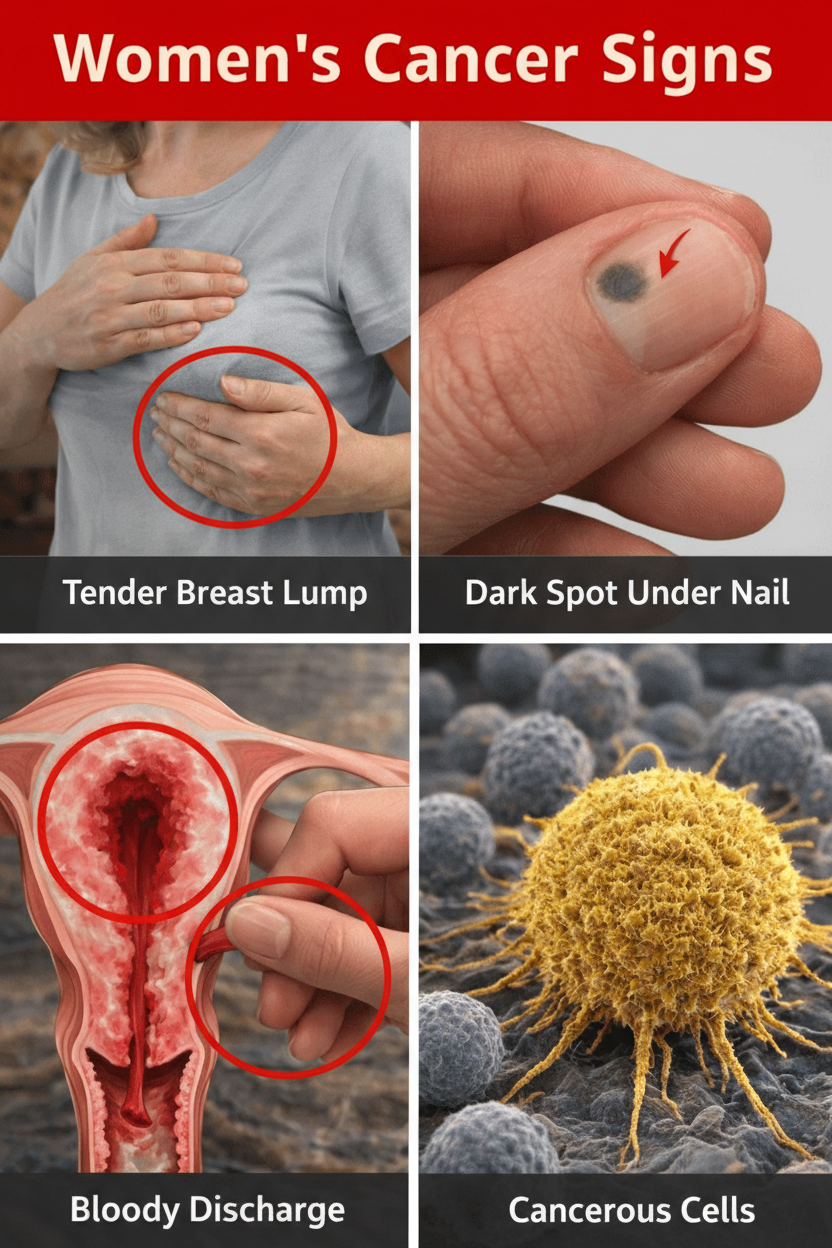
A constant, dull ache or persistent pressure in the lower abdomen or pelvis that doesn’t subside with time or typical remedies.
Why often ignored: “It’s probably just period pain” or “I must have strained a muscle.”
9. Unusual Vaginal Bleeding or Discharge
- Any bleeding after menopause (even a small amount).
- Bleeding that occurs between your regular menstrual periods.
- Vaginal discharge that is watery, bloody, or possesses an unusual, foul odor.
Why often ignored: “My periods are just irregular” or “It’s probably a minor infection.”
General & Systemic Signs
Sometimes, cancer manifests through more generalized body signals.
10. Unexplained Weight Loss
Losing 5–10% or more of your body weight without intentionally trying to do so, for example, without changes in diet or exercise.
Why often ignored: “I’m finally eating healthier” or “It’s just stress.”
11. Persistent Fatigue/Weakness
Extreme and overwhelming tiredness that doesn’t improve with adequate rest, and significantly impacts daily activities.
Why often ignored: “I’m just getting older” or “My life is too busy.”
12. Swelling in Legs/Ankles or Abdomen
Persistent fluid retention or swelling that accumulates in your legs, ankles, or abdomen, and often worsens as the day progresses.
Why often ignored: “I’ve had too much salt” or “I’ve been standing too long.”
13. Yellowing of Skin/Eyes (Jaundice)
Even a slight yellow tint to your skin or the whites of your eyes, indicating potential liver issues.
Why often ignored: “It’s just the lighting” or “It must be my diet.”
14. Persistent Cough/Hoarseness + Weight Loss
A chronic cough or a raspy voice that lasts for several weeks, especially when coupled with unexplained weight loss.
Why often ignored: “It’s just my allergies acting up” or “It’s a cold that won’t go away.”
Quick Urgency Guide – When to Act
Understanding the severity of symptoms can help you decide when to seek medical attention.
- Emergency (ER or Doctor Same Day):
- Sudden, severe abdominal or pelvic pain accompanied by fever or vomiting.
- Heavy vaginal bleeding (soaking through a pad in less than one hour).
- Sudden inability to urinate or difficulty swallowing.
- Yellowing skin/eyes combined with dark urine and pale stools.
- Urgent (Within Days):
- Any amount of postmenopausal bleeding.
- A new lump accompanied by unexplained weight loss or persistent fatigue.
- Persistent bloating coupled with early satiety (feeling full quickly) and urinary urgency.
- Prompt (Within 1–2 Weeks):
- Any 2–3 of the listed signs persisting for more than 3–4 weeks.
- New or worsening symptoms, particularly if there is a family history of cancer.
The Bottom Line: Don’t Delay, Act Today
Cancer in women often begins with subtle, visible, or easily detectable changes that are unfortunately overlooked for far too long. These 14 signs represent the most consistent early warnings reported by patients who were later diagnosed – especially when multiple signs persist and do not resolve on their own. If even two or three of these symptoms continue for more than 3–4 weeks (particularly abnormal bleeding, persistent bloating, a new lump, or unexplained weight loss), do not wait for symptoms to worsen.
A straightforward visit to your gynecologist, primary care physician, or a specialist can involve essential screenings such as blood tests, ultrasound, Pap/HPV tests, mammograms, or colonoscopies – often leading to the detection of issues at a highly treatable stage. You are the expert on your own body. Trust your instincts regarding persistent changes – early intervention truly saves lives.
Action Step: Take a moment tonight to examine yourself in a mirror – check your breasts, skin, abdomen, and neck for any unusual lumps, patches, or persistent changes from this comprehensive list. If anything feels “off” for several weeks, make it a priority to schedule a check-up this month.
Disclaimer: This article is intended solely for informational purposes and does not constitute medical advice. Always consult with a qualified healthcare professional for any health concerns or before making any decisions related to your health or treatment.